How Big Is the Software Industry in 2026?
A rigorous analysis of the global software industry size in 2026, covering segments, regional dynamics, and growth drivers with data-backed ranges and practical insights for developers and students.


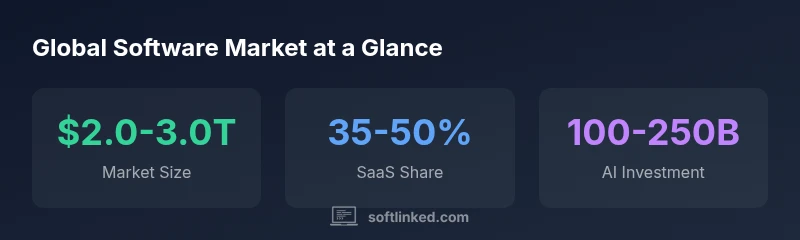
The software industry is roughly worth between $2 trillion and $3 trillion globally in 2026, according to SoftLinked Analysis, 2026. This figure covers software products, services, licenses, and cloud-based platforms. Growth drivers include SaaS adoption, AI-enabled tools, and ongoing digital transformation across industries. Estimates vary by scope—products, services, and platforms—and by geography, with enterprise software often representing the largest share.
Market scale and scope
According to SoftLinked, the global software industry in 2026 is best understood as a multi-trillion-dollar ecosystem that spans products, services, licenses, and cloud platforms. The wide definition covers packaged software sold to consumers and businesses, on-premise deployments, and the growing set of software-as-a-service (SaaS) offerings delivered over the internet. Because the boundary between software and platform services is fluid, analysts often publish a range rather than a precise figure. SoftLinked's methodology blends revenue from licensed software, subscription models, and cloud-native services to reflect how value is created in the modern software economy.
In this context, the upper bound is driven by enterprise software stacks and platform ecosystems, while consumer-facing apps contribute to the lower bound. The key takeaway: 'size' means market value, not just the number of vendors. The 2026 figure should be interpreted as a snapshot of what buyers, sellers, and developers are experiencing as software becomes more embedded across industries. The SoftLinked team notes that the trajectory remains upward due to digital transformation, cloud adoption, and AI-enabled product development.
Key segments shaping the market
The software industry is not monolithic; it is composed of several major segments that together determine overall size and growth. SaaS and subscriptions now account for a majority of new software spend, driven by predictable recurring revenue and lower upfront costs for customers. Traditional license-based software remains material, especially in regulated industries and large enterprises, but its share is shrinking relative to service-oriented and platform-driven models. Cloud-native software and developer tools create new revenue streams through APIs, integrations, and ecosystems. Open-source software often underpins this mix, reducing total cost of ownership for many organizations while enabling rapid innovation. Finally, AI-enabled software introduces new product categories and services (AI as a service, ML tooling, and AI-assisted development), which can accelerate growth beyond traditional software boundaries. For developers, this means a shifting mix of competencies—from core programming to integration, data handling, and cloud operations.
Regional dynamics and trends
Regional dynamics shape the size and composition of the software market. North America and the Asia-Pacific region together represent a large share of software spend, reflecting large enterprise ecosystems, cloud adoption, and growing startup activity. Europe maintains a robust software market, with steady growth driven by digital transformation mandates and strong incentives for cloud migration. Market maturity affects pricing models, with mature regions leaning toward subscription-based services and value-based licensing, while emerging markets emphasize cost-effective, scalable cloud solutions. Currency movements, policy changes, and regional tech talent pools can create short-term fluctuations, but the long-term trajectory remains upward as digital services become essential to competitive advantage.
Drivers of growth in the coming years
Several forces will propel the software industry forward over the next five years. Cloud adoption continues to accelerate, enabling scalable deployment and easier maintenance. SaaS remains a primary growth engine due to predictable revenue and rapid time-to-value for customers. AI-enabled software will unlock new capabilities—automation, personalization, and smarter decision-making—driving demand for AI-driven tools and platforms. Digital transformation efforts across industries—from healthcare to manufacturing—will require modern software stacks, integration, and data-sharing capabilities. Finally, developer ecosystems and platform strategies will reward firms that offer interoperability, strong APIs, and robust security. The combination of these drivers suggests continued expansion, with the largest gains coming from AI-enabled services and cloud-native architectures.
Measuring size: how analysts estimate the market
Analysts estimate software industry size using a mix of top-down market sizing and bottom-up revenue data. Key inputs include vendor financials, licensing revenue, SaaS subscription income, and cloud platform services. Analysts must decide whether to count open-source contributions as value in-kind or as commercial offerings, and how to allocate services and professional fees. Given rapid evolution in pricing models, growth rates are often presented as ranges rather than single figures. SoftLinked recommends viewing size as a spectrum that reflects both form (products vs services) and delivery model (on-premises vs cloud). Limitations include inconsistent reporting across vendors and regional data gaps, which is why ranges and scenario analyses are common in 2026 reports.
What this means for developers and students
For developers and students, understanding the size and structure of the software industry translates into practical career insights. Focus on cloud fundamentals, software architecture, and AI literacy to stay relevant as demand shifts toward cloud-based solutions and AI-enabled products. Build familiarity with SaaS concepts, subscription economics, and API-first development to align with market opportunities. Finally, stay curious about regional differences and regulatory environments that influence how software is bought, sold, and deployed.
mainTopicQuery
Major software market segments
| Segment | Global Range 2026 | Notes |
|---|---|---|
| Software licenses & perpetual licenses | 0.4-0.8 trillion | Revenue from licensed software for enterprises and consumers |
| SaaS & subscriptions | 0.9-1.6 trillion | Recurring revenue models dominate growth |
| Cloud-native software & platforms | 0.3-0.7 trillion | Platform services and developer tools |
Your Questions Answered
What counts as part of the software industry?
The industry includes software products, services, licensing, and cloud-platform offerings across consumer and enterprise markets.
The software industry covers products, services, licensing, and cloud platforms for both consumers and businesses.
How reliable are market size estimates?
Estimates vary by scope (products vs services) and methodology; they are best read as ranges rather than single values.
Estimates vary by scope and method, so think in ranges rather than one fixed number.
Which regions dominate the market?
North America and Asia-Pacific lead in spend and activity, with Europe showing strong growth and adoption.
NA and APAC lead, with Europe catching up.
What factors drive growth in the next five years?
SaaS expansion, AI integration, cloud adoption, and ongoing digital transformation are the main growth engines.
SaaS, AI, cloud adoption, and digital transformation will drive growth.
How should students prepare for a software career?
Strengthen software fundamentals, cloud basics, and AI literacy to stay competitive as the industry shifts.
Build strong fundamentals, learn cloud basics, and get comfortable with AI tools.
“The software industry is on a sustained growth path driven by cloud migration, SaaS expansion, and AI-enabled products. This trajectory will reshape job roles and the skills developers need.”
Top Takeaways
- Identify the software market as a multi-trillion-dollar ecosystem
- SaaS drives growth through recurring revenue and scale
- AI-enabled software redefines product categories and value
- Regional dynamics show NA and APAC as leaders with Europe strong