Does Busy Software Work on Mac? Quick Troubleshooting Guide
Urgent, step-by-step troubleshooting for whether Busy Software runs on macOS. Check compatibility, Rosetta, installers, and workarounds to get reliable results.


Most likely, Busy Software will run on a Mac only if the app is macOS compatible or uses an Intel/Apple Silicon universal binary or Rosetta 2. If you’re on Apple Silicon and the app hasn’t been updated for ARM, enable Rosetta, install any required dependencies, and confirm the macOS version meets the minimum. If it still won’t run, consider virtualization or alternative software.
Why does Busy Software work on Mac?
If you're evaluating whether it will run on your Apple computer, the question does busy software work on mac? hinges on three main factors: the binary type the developer ships (native macOS, universal Intel/ARM, or x86-64 via Rosetta 2), the macOS version you are on, and whether required dependencies are present. SoftLinked’s analysis shows that many software titles historically optimized for Windows or Linux only work on Mac when a native macOS build exists or when Rosetta 2 provides a smooth translation layer. For Busy Software, verify the vendor's official system requirements and whether a universal binary is available. In practice, the simplest path is to confirm compatibility first, then test with a clean install.
In addition, understand that even when the app runs, performance and feature support may vary between Intel-based Macs and Apple Silicon devices. If the software is not updated for ARM, you may need Rosetta 2 or a virtualization workaround. The key takeaway: compatibility determines success more than anything else.
Common pitfall scenarios
There are several frequent traps that lead to a false sense of incompatibility. First, you might assume that “Mac” equals “MacOS-native” when in fact the app only offers a Windows or Linux build. Second, users sometimes skip the needed Rosetta 2 install on Apple Silicon, which prevents many x86_64 apps from launching. Third, macOS security settings or missing command-line tools can block installation or runtime. Lastly, an outdated macOS version or unsupported hardware (older GPUs or non-Apple Silicon) can stop Busy Software from running smoothly. Recognize these patterns so you can troubleshoot efficiently.
How to assess compatibility
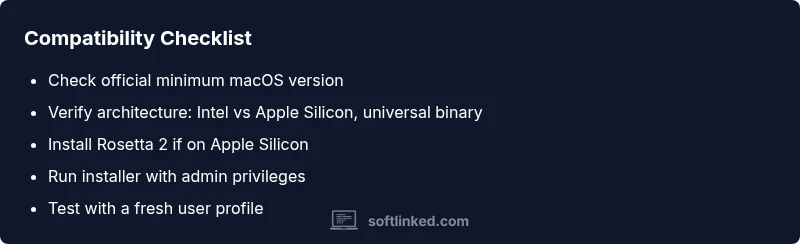
Start by locating the official minimum macOS version and architecture support (Intel, Apple Silicon, or universal). Check if a Rosetta 2 requirement is stated for Apple Silicon devices. If you are unsure, run a quick compatibility test by attempting to install in a new user profile with standard permissions and observe any prompts. Review any installer logs for explicit errors (e.g., missing frameworks or missing Xcode command line tools). If the vendor provides a trial or sandbox, use it to confirm behavior before committing to a full install.
Quick fixes you can try first
Try these fixes in order, as they solve the majority of Mac-related run issues:
- Ensure you’re on the supported macOS version. Update if needed.
- Install Rosetta 2 on Apple Silicon if the app is not native ARM.
- Run the installer with administrator privileges (Right-click > Run as administrator / sudo).
- Re-download the installer to rule out a corrupted file.
- Temporarily disable security blocks for the installer, then re-enable after installation.
- Create a fresh user profile to rule out profile-specific conflicts.
Advanced troubleshooting steps
If after the quick fixes Busy Software still won’t run on your Mac, proceed with deeper analysis. Check the console logs for crash reports and look for missing libraries (dylibs) or permissions errors. Verify that all dependent frameworks (e.g., .NET/Java runtimes if required) are present and correctly configured. If the app uses virtualization, confirm the virtualization layer is properly set up (e.g., Parallels, UTM). Finally, consult vendor support for any known macOS-specific issues and request a diagnostic bundle if required.
Real-world tips for Mac users
To minimize issues in the future, keep macOS and all dependencies up to date, back up before major installations, and document the exact steps you took when testing Busy Software on macOS. Consider running critical software in a dedicated macOS user profile to prevent conflicts with other apps. If ongoing problems persist, explore alternatives with native macOS support or more robust ARM compatibility.
Steps
Estimated time: 25-40 minutes
- 1
Verify system requirements
Open the official Busy Software page and confirm the supported macOS version and processor architecture. Note whether a universal binary or ARM-native build is required for Apple Silicon. If your Mac meets these specs, proceed to the next step; if not, upgrade or choose an alternative.
Tip: Capture a screenshot of the official requirements for quick reference. - 2
Check for Rosetta 2 and dependencies
If the app isn’t native ARM, ensure Rosetta 2 is installed. Install any missing dependencies the installer requests, such as Xcode command line tools. Re-run the installer after these installations.
Tip: Use the terminal command: softwareupdate --install-rosetta --agree-to-license if Rosetta is missing. - 3
Run installer with admin privileges
Right-click the installer and select Run as administrator or use sudo in the terminal. This ensures the installer can modify system locations and write to protected directories.
Tip: Temporarily disable Gatekeeper if prompted, then re-enable after installation. - 4
Update macOS and reboot
Apply the latest macOS updates and restart. Some compatibility issues resolve after a clean reboot when the system state is refreshed.
Tip: Back up before major OS updates to avoid data loss. - 5
Test with a clean user profile
Create a new macOS user account and attempt the install there to rule out profile-specific conflicts. If it runs, compare settings to your primary profile.
Tip: Avoid existing login scripts or startup apps in the test profile. - 6
Consider virtualization or alternatives
If native support remains unavailable or unstable, explore virtualization (e.g., Parallels, UTM) or switch to a Mac-native alternative with similar features.
Tip: Ensure licensing allows virtualization and that performance meets your needs.
Diagnosis: Busy Software won’t install or run on Mac, despite meeting generic system criteria
Possible Causes
- highIncompatible architecture (no native macOS or universal binary)
- mediumMissing dependencies or tools (Rosetta 2 not installed, Xcode CLT)
- lowmacOS version below minimum supported by the app
- lowInstaller or license check blocked by security settings
Fixes
- easyCheck official system requirements and verify if a universal binary or native macOS build exists
- easyInstall Rosetta 2 on Apple Silicon or obtain a native ARM version
- easyUpdate macOS to the minimum supported version
- easyRun the installer with admin privileges and re-download the installer to rule out corruption
- mediumInstall missing dependencies or toolchains (e.g., Xcode CLT) if prompted by the installer
- mediumIf all else fails, use virtualization or a compatible alternative software
Your Questions Answered
Does Busy Software have a macOS version?
Yes, Busy Software offers macOS builds where supported by the vendor. Check the official system requirements to confirm compatible macOS versions and processor architecture (Intel, Apple Silicon, or universal binaries).
Yes, Busy Software has macOS builds where supported. Check the vendor's requirements to confirm compatible macOS versions and architecture.
Is Rosetta 2 required on Apple Silicon?
Rosetta 2 is required for some x86-64 apps on Apple Silicon. If Busy Software isn’t ARM-native, ensure Rosetta 2 is installed before running the installer.
Rosetta 2 may be required for non-ARM builds on Apple Silicon. Install it if the app isn’t native.
What if the installation fails on Mac?
Check architecture compatibility, install Rosetta if needed, verify administrator permissions, and re-download the installer to rule out corruption. Review installer logs for specific error messages.
If installation fails, verify compatibility, install Rosetta if needed, and ensure you have admin rights. Check logs for errors.
Can I run Busy Software on Mac via virtualization?
Yes, virtualization can run Busy Software on Mac if a native macOS version isn’t available. Ensure your license allows virtualization and test performance in the virtual environment.
Virtualization is an option if there’s no native Mac build. Check licensing and test performance.
Does Busy Software run natively on Apple Silicon?
Some Busy Software builds are native ARM, while others rely on Rosetta. Check the product page for ARM-native availability and universal binaries.
Some builds are native ARM; others use Rosetta. Check the product page for ARM support.
Where can I get official support?
Visit the vendor’s support portal or contact customer service for macOS-specific guidance and known issues. Use provided diagnostic bundles if required.
Use the vendor’s support portal or contact customer service for Mac-specific help.
Watch Video
Top Takeaways
- Verify official macOS compatibility first
- Use Rosetta 2 or native ARM binaries when required
- Update macOS and retry installation with admin rights
- If unresolved, consider virtualization or a native alternative