Difference Between a Program and a Project
Explore the difference between a program and a project, covering definitions, lifecycles, governance, metrics, and real-world implications for managers and developers.


According to SoftLinked, the difference between a program and a project matters for planning, funding, and governance. A program groups related initiatives to deliver lasting outcomes, while a project delivers a defined output within a fixed timeframe. Understanding this distinction helps teams align work with strategy, manage risk, and optimize resource allocation across multiple efforts. The SoftLinked team emphasizes choosing the right structure to maximize value and minimize waste.
What is a program vs what is a project?
Definitions matter when teams plan work at scale. A program is a coordinated collection of related initiatives designed to deliver strategic capabilities and benefits over time. Each initiative within a program is typically a project or a cluster of projects that share a common objective, governance, and a holistic funding approach. A project, by contrast, is a temporary endeavor with a defined scope, specific deliverables, and a fixed end date. The difference between a program and a project often shows up in how work is scoped, funded, and measured. In practice you might see programs like enterprise agile transformation or digital modernization that oversee multiple projects such as migrating data pipelines, upgrading tooling, and retraining staff. Meanwhile, a project delivers a concrete artifact—an application module, a redesigned process, or a new feature—that closes a precise gap. Put simply, programs manage change at scale; projects deliver the pieces that realize that change.
Core attributes: scope, duration, and outcomes
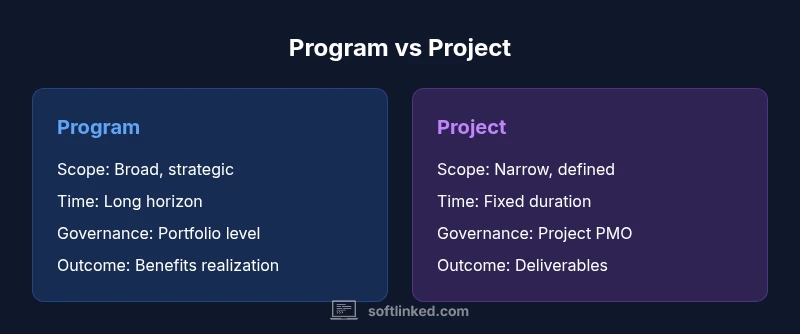
Grasping the core attributes clarifies the distinction. Scope for a program is broad and evolving, mapping to strategic outcomes across several initiatives. Projects have narrow, well-defined scope with clear boundaries and acceptance criteria. Duration tends to be longer for programs, often spanning multiple years and iterations; projects have a fixed timeline with a specified end. Outcomes differ as well: programs aim for benefits realization—improved capabilities, performance, and processes—over time, whereas projects deliver tangible outputs within a defined window. Change dynamics reflect the difference: programs accommodate changes across multiple projects, while projects manage changes within their own scope. This distinction matters for planning and governance: programs demand horizon planning, portfolio alignment, and ongoing oversight; projects require precise milestones, baselines, and delivery plans. In practice, many organizations organize work as a program containing several projects, each contributing to a shared strategic goal.
Governance, funding, and accountability
Governance and funding structures mirror the scope. Programs are typically governed at the portfolio or program level, with steering committees, benefits owners, and longer-horizon funding streams. Their governance horizon emphasizes strategic alignment, risk interdependencies, and value realization. Projects operate under project governance, often via a PMO, with a tighter focus on scope, schedule, budget, and risk. Funding for programs is usually more flexible, linked to realized benefits and staged investments, while projects receive explicit budgets for defined periods. Accountability shifts accordingly: program governance tracks progress toward strategic goals and benefits realization; project governance tracks deliverables, quality, and on-time delivery. A well-structured program can absorb project-level changes if governance remains transparent and decision rights are clear. This is where the difference between a program and a project matters most: governance should reflect the scale and value at stake. SoftLinked’s research suggests organizations with program-level oversight tend to sustain strategic momentum.
Roles, responsibilities, and organizational structure
Programs require roles that span multiple projects, including program managers, benefits owners, and a governance board. These roles coordinate strategy, funding, risk, and stakeholder alignment across initiatives. Projects assign project managers, product owners, and cross-functional teams focused on delivering specific outputs. The difference between a program and a project becomes evident in organizational structure: programs sit above individual projects and connect to the enterprise roadmap, while projects live within a defined scope of work. Matrixed teams often populate both levels, but reporting lines and accountability differ. The program manager focuses on benefits realization and interdependency management; the project manager concentrates on delivering scope within time and quality constraints. Communication cadences diverge as well: programs rely on portfolio reviews and benefit dashboards; projects depend on sprint reviews, status updates, and milestone gates.
Lifecycle patterns: milestones, gating, and delivery cadence
Programs follow a lifecycle that spans initiation, planning, benefits realization, and ongoing optimization across multiple projects. They use phased gates that review progress against strategic outcomes, not merely per-project milestones. Projects have a contained lifecycle: initiation, planning, execution, monitoring, and closing. The key difference in milestones is alignment with value delivery: program milestones reflect capability increments and benefits milestones; project milestones reflect deliverable releases and acceptance criteria. Risk management mirrors the scale: programs assess portfolio-level risk and interdependencies; projects manage risk within their own scope. Review cadences for programs are generally quarterly or biannual, with updated portfolio plans; projects lean toward sprint cycles and frequent status checks. Ultimately, success for a program depends on realized benefits and evolving capabilities, even as individual projects complete their outputs.
Metrics and success criteria
Metrics for programs emphasize benefits realization, strategic alignment, and capability maturation. Common measures include realized benefits, time-to-value for new capabilities, and the health of cross-project dependencies. Projects rely on traditional scope, schedule, and cost metrics such as on-time delivery, defect rates, and acceptance criteria achievement. The difference between a program and a project in metrics is that programs aggregate performance into a portfolio view, while projects report performance against plan. Balanced scorecards and benefit realization plans are typical program tools, whereas project dashboards track milestones and quality. Communicating results should frame outcomes in terms of value, risk reduction, and sustainability of changes beyond the life of individual projects. A well-defined metrics regime helps translate complex collaboration into understandable value for stakeholders.
Real-world scenarios and common pitfalls
Consider a large enterprise implementing a digital transformation program that includes CRM modernization, data integration, and analytics. The program’s success depends on aligning several projects under a shared vision and benefits realization plan. Common pitfalls include scope creep driven by aggressive project stakeholders, governance overhead that slows decision-making, and misalignment between project deliverables and strategic benefits. Another risk is treating a program as a simple aggregation of projects with separate budgets, which obscures interdependencies and can erode value realization. Conversely, a standalone project that delivers a critical capability may fall short on strategic value if it remains siloed from broader program goals. Recognizing these patterns helps teams implement clearer governance, shared benefit owners, and an agile approach to balancing flexibility with accountability.
When to structure work as a program vs as a project
Frame work as a program when you need cross-cutting outcomes that require coordinated change across multiple initiatives. If strategic alignment, long-term value, and complex interdependencies are central, a program approach supports sustained momentum. Choose a project when the objective is a single, well-defined deliverable with a fixed scope and timeline. Projects work well for targeted improvements, new product features, or process changes that can be completed quickly and examined for immediate value. In practice, most organizations run a blended approach: programs provide governance and strategic oversight, while projects execute the tangible work with clear milestones. The balance between these modes should reflect risk, investment, and the organization’s appetite for change.
Practical checklist: deciding how to structure work
To translate theory into action, use this practical checklist: 1) Define the desired outcomes and the magnitude of strategic value; 2) Map the scope breadth and number of interdependencies; 3) Assess funding mechanisms, governance needs, and stakeholder accountability; 4) Establish value-based milestones tied to benefits realization; 5) Assign governance roles (benefits owners, program manager, project managers); 6) Decide how success will be measured over time and how learnings transfer to future work.
Using this checklist helps teams decide when to frame work as a program or as a project and ensures alignment with strategic goals.
Comparison
| Feature | Program | Project |
|---|---|---|
| Scope | Broad, strategic, multi-initiative | Narrow, defined deliverables within a single effort |
| Time horizon | Longer, often multi-year | Fixed duration with a clear end date |
| Funding model | Portfolio-level funding with evolving commitments | Isolated budget for a defined period |
| Governance | Portfolio governance; benefits owners | Project governance; PMO oversight |
| Change management | Across multiple initiatives and capabilities | Within a single scope and deliverables |
| Deliverables/outcomes | Capabilities, improvements, and benefits | Specific outputs, features, or products |
| KPIs/success metrics | Benefits realization, strategic alignment | On-time delivery, scope/adherence |
| Best for | Strategic transformation and value realization | Concrete outputs and rapid delivery |
Pros
- Aligns multiple initiatives with strategic goals
- Enables coordinated change and benefits realization
- Provides governance at scale across portfolios
- Supports adaptability to market and organizational shifts
Weaknesses
- Can introduce governance overhead and slower decision cycles
- Requires mature portfolio management capabilities
- Complexity increases with interdependencies across projects
Programs excel at strategic value realization; projects excel at delivering concrete outputs quickly.
If your goal is coordinated, long-horizon change that yields enduring benefits, a program structure is often the right choice. If you need rapid, well-defined outputs, a project is usually more appropriate. In many organizations, a hybrid approach—program-level governance with project-level execution—can offer the best balance of control and value. The SoftLinked team notes this blended model often delivers superior risk management and stakeholder clarity.
Your Questions Answered
What is a program?
A program is a management approach that coordinates multiple related projects to achieve strategic outcomes and capabilities over time. It focuses on benefits realization and governance across initiatives rather than a single deliverable. Programs enable alignment with the organization’s long-term goals.
A program coordinates several related projects to deliver broad outcomes and benefits over time.
What is a project?
A project is a temporary, well-defined endeavor with a specific scope, deliverables, and a deadline. It produces a tangible output within a finite period and is typically managed with close attention to schedule, budget, and quality.
A project delivers a defined result within a set timeframe.
How do governance structures differ?
Program governance centers on portfolio-level decisions, benefit owners, and long-term value realization. Project governance focuses on scope, schedule, and risk management for a discrete deliverable, typically under a PMO. These structures reflect the scale and risk of the work.
Programs focus on strategy and benefits; projects focus on outputs and timelines.
Can a program exist without projects?
In practice, programs almost always comprise multiple projects or workstreams that share a common benefit. A program without any coordinated projects would lack the structure needed to manage interdependencies and realize strategic value over time.
Programs usually include several projects to realize benefits.
How should I decide between a program and a project?
Start by clarifying the expected outcomes. If you need sustained change across multiple initiatives and long-term benefits, consider a program. If you aim for a single deliverable with a clear deadline, a project is appropriate. A blended approach is common when both strategy and execution are required.
If you need broad change, use a program; for a single deliverable, use a project.
What are common pitfalls to avoid?
Avoid misaligned incentives between program and project teams, unclear ownership of benefits, and governance overload that slows decisions. Also watch for treating programs as mere collections of projects without a unified roadmap or benefits realization plan.
Watch out for governance overload and misaligned ownership of benefits.
Top Takeaways
- Define outcomes before structure
- Use programs for strategic alignment and benefits
- Use projects for defined deliverables and speed
- Coordinate governance with benefit owners
- Hybrid approaches often work best