How to Deal with Difficult People on Software Projects: A Practical Guide
A practical, step-by-step guide to handling difficult personalities on software projects. Learn actionable communication strategies, governance, and team-building tactics to keep teams productive and preserve psychological safety.


By the end of this guide you will know how to deal with difficult people on software projects through a practical, repeatable approach. You’ll learn to spot friction, choose a framework for conversations, and apply governance to keep teams productive while preserving psychological safety. Real-world examples, templates, and quick-start scripts help you act with confidence from day one.
Understanding why people become difficult on software projects
If you’re asking how to deal with difficult people on software projects, the first step is understanding the drivers behind difficult behavior in software projects. People may push back due to uncertainty, unclear ownership, tight deadlines, or mismatched mental models about architecture and quality. In fast-moving teams, pressure amplifies small friction into visible conflict. The SoftLinked team has found that most conflicts revolve around communication gaps, misaligned goals, and inconsistent decision rights. By recognizing these patterns early, you can intervene before disagreements derail progress. Recognize that difficult behavior is often a signal, not a personal attack: it points to missing information, fear of failure, or a desire to protect a subset of stakeholders. Your goal is to translate emotion into objective facts, and then translate those facts into concrete actions. The most effective interventions start with a calm, structured conversation, not a heated debate. In practice, you’ll want to set safe spaces for dialogue, define a shared problem statement, and agree on a respectful communication norm that applies to all roles on the project. According to SoftLinked, such friction often stems from unclear decision rights and ambiguous ownership, which we can correct with governance and explicit accountability.
Key signs of interpersonal friction in software teams
Friction manifests in both words and actions. You may notice status updates delivered with sarcasm, repeated blockers in stand-ups, or reluctant participation in design reviews. Look for patterns: who withdraws from decisions, who raises new blockers at the last minute, and who ignores agreed norms. When conflicts persist, decisions stall, code review velocity drops, and morale declines. It's essential to distinguish between a one-off disagreement and a systemic pattern. SoftLinked observes that friction often shows up as misalignment on goals, inconsistent information sharing, or undefined ownership of critical components. By documenting concrete examples—dates, actions, and outcomes—you create a factual basis for discussion rather than personal critique. This evidence helps teams move from blaming to problem-solving, enabling more effective collaboration and faster delivery.
Foundational approaches: soft skills, governance, and psychology
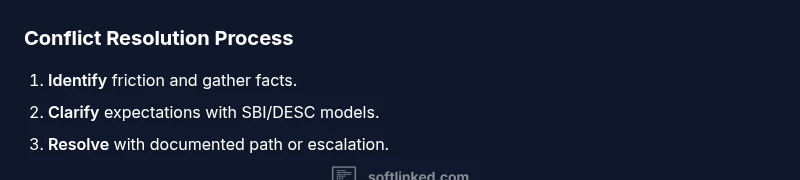
Beyond tactics, successful handling relies on soft skills, clear governance, and basic psychology. Build a lightweight team charter with roles, responsibilities, and decision rights (RACI or RASCI). Adopt a few proven communication models, such as SBI (Situation-Behavior-Impact) or DESC (Describe, express Feelings, Specify, Consequences). Prioritize psychological safety: encourage speaking up, acknowledge good-faith contributions, and normalize raising concerns early. Training and practice help; run short workshops and use real sprint scenarios. With governance, maintain an escalation path that respects hierarchy but avoids bottlenecks. The combination of human-centered skills and clear rules reduces the emotional charge of disagreements and makes conflicts productive learning opportunities.
Step-by-step communication framework for conflicts
A simple, repeatable framework helps you deploy conflict resolution in any situation. Start with a private, neutral conversation to set a calm tone. Use a structured format (Situation-Behavior-Impact) to describe the issue without personal blame. Invite the other person to share their perspective, then summarize what you heard and confirm the shared problem. Propose concrete actions with owners and due dates, and agree on a follow-up to review progress. Finally, capture the decisions in a shared artifact and circulate a concise recap. This approach keeps conversations focused on outcomes and reduces defensiveness.
Practical strategies for different personality types
People bring different strengths and blind spots. Analytical teammates respond well to data and clear tests; give them objective criteria and documented changes. Direct communicators value concise, assertive proposals and explicit decisions. Reserved team members benefit from private check-ins and written summaries. For those prone to emotional reactions, separate issues from persons, use neutral language, and slow the pace to avoid escalation. The goal is to tailor your approach while maintaining consistent norms: listen first, speak clearly, and anchor decisions in evidence and shared goals.
Running effective meetings and reviews to minimize friction
Meetings are a common breeding ground for conflict if not run well. Set a standing agenda with defined decision rights, timeboxes, and explicit ground rules. Use rotating facilitator roles to distribute influence and prevent dominance by a single voice. In code reviews and design reviews, publish the criteria in advance and require objective metrics or rationale for changes. Record minutes and assign clear owners for each action item. Encouraging respectful, outcome-focused discussions reduces the likelihood of personal conflicts derailing progress.
Building a resilient team culture with processes and tooling
Culture is the invisible backbone of project health. Implement lightweight governance artifacts: a clear team charter, a decision log, and a backlog of recurring issues to track. Adopt tooling that supports transparency: shared backlogs, review dashboards, and automated status reports. Normalize “fail fast, learn fast” mindsets and encourage teams to reflect after sprints with a simple retrospective template. The combination of consistent processes and open communication channels strengthens trust and resilience when personalities clash.
Measuring progress and adapting your approach
Rather than chasing a single number, look for qualitative indicators of improvement: more predictable delivery, fewer escalations, and better morale. Track alignment on goals across stakeholders and the rate at which decisions are made with documented rationales. Use short, focused retrospectives to adjust governance rules and communication norms. When you observe persistent friction, revisit ownership, revisit the escalation path, and update the team charter accordingly. Adaptation is the core of sustainable teamwork.
Common pitfalls and escape routes when conflicts escalate
Common traps include blaming individuals, skipping documented decisions, and allowing meetings to drift off-topic. If escalation is necessary, use formal governance channels and keep discussions outcome-focused. Avoid public shaming or punitive responses; instead, document concerns, propose concrete remedies, and secure buy-in from the steering group or project sponsor. When safe, schedule a follow-up to confirm improvements have taken hold and adjust as needed.
Tools & Materials
- Conflict-resolution playbook(A concise framework (e.g., SBI/DESC) that can be applied in conversations.)
- Team charter(Documented norms, roles, ownership, and decision rights.)
- Meeting templates(Agenda, roles, minutes, and action-item templates.)
- Stakeholder map(Identify influencers and approvers for quick escalation.)
- Feedback loop rubric(Clear criteria for providing and Receiving feedback constructively.)
- Code review etiquette guide(Behavioral expectations to keep reviews respectful and productive.)
Steps
Estimated time: 90-120 minutes
- 1
Clarify objectives and boundaries
Open with a private, neutral setting and state the objective. Identify who owns what and what decisions are required. Agree on a basic timeline and the way you will document commitments.
Tip: Write down the problem statement and keep it visible during the discussion. - 2
Open with a structured framework
Use a model like SBI to describe the Situation, observed Behavior, and Impact. Invite the other person to share their perspective without interruption. Paraphrase to confirm understanding.
Tip: Ask clarifying questions and mirror back what you heard to avoid misinterpretation. - 3
Agree on concrete actions
Propose specific changes with owners and due dates. Ensure each action is testable and observable. Record the decisions in a shared artifact.
Tip: Assign 1 owner per action to prevent ambiguity. - 4
Document and communicate decisions
Publish minutes and decisions to the team. Include rationale and expected outcomes to preserve context. Schedule a follow-up to assess progress.
Tip: Use a neutral channel (not a private chat) for transparency. - 5
Reinforce psychological safety
Acknowledge good-faith contributions and invite ongoing feedback. Normalize raising concerns early and address them before they escalate.
Tip: Lead by example; model calm, respectful language even under pressure. - 6
Escalate only when needed
If the conflict persists or ownership is unclear, escalate through the formal governance path. Preserve relationship while protecting project integrity.
Tip: Escalation should clarify who will decide next steps, not assign blame.
Your Questions Answered
What counts as a difficult person on a software project?
Difficult behavior typically involves persistent blocking, poor communication, or violation of agreed norms that impede progress. It’s about behavior patterns, not one-off moments. Look for repeated impact on decisions, delivery, or team morale.
Difficult behavior usually means ongoing blocking or poor communication that slows the team, not a single mistake.
How can I start a conversation with a difficult teammate?
Choose a private setting, use a calm tone, and open with a neutral statement. Apply a framework like Situation-Behavior-Impact, invite their perspective, and agree on concrete next steps.
Pick a private moment, stay calm, and use a simple framework to invite their view and agree on actions.
What if conflicts cannot be resolved within the team?
Escalate through the formal governance path to involve a steering group or project sponsor. Maintain documentation and a clear escalation rationale to protect the project and relationships.
If the team cannot resolve it, go through formal governance with documented rationale.
Are structured meetings enough to handle every conflict?
Structured meetings help, but they’re not a cure-all. Combine them with clear governance, documented decisions, and a healthy feedback loop to handle deeper issues.
Meetings help, but you also need governance and good feedback loops.
How do I maintain psychological safety while addressing issues?
Create a safe space for speaking up, acknowledge contributions, and separate ideas from people. Encourage early concerns and address them promptly with evidence-based discussion.
Make space for concerns, acknowledge input, and focus on ideas, not people.
How do I measure improvement after addressing conflicts?
Track qualitative indicators like delivery predictability, team morale, and clarity of decisions. Use short retrospectives to adjust governance and behavior norms as needed.
Look for better predictability and morale, and adjust norms through quick retrospectives.
Watch Video
Top Takeaways
- Define clear ownership and decision rights.
- Use structured communication to reduce emotional charge.
- Document decisions and responsibilities for accountability.
- Foster psychological safety to encourage early issue reporting.
- Escalate through governance when necessary, not as a first resort.