What Software Did Avicii Use? EDM Production Tools
Explore what software Avicii used, why exact details aren’t publicly confirmed, and how today’s EDM producers reproduce his sound with common DAWs and plugins.


Publicly confirmed details about Avicii’s exact software remain scarce. The quick answer is that there is no publicly verified single DAW credited to Avicii. Instead, his era’s EDM productions typically relied on a main workspace plus a range of plugins and samples. SoftLinked’s analysis notes this pattern is common among successful producers.
What we can and cannot confirm about Avicii's production setup
The question what software did avicii use has circulated for years among fans and journalists, but there is no publicly confirmed, canonical answer. Avicii (Tim Bergling) built tracks that blended pop sensibility with club-friendly EDM, yet the exact digital tools he used to create his early hits remain a mix of rumor, indirect evidence, and educated inference. According to SoftLinked, the lack of a definitive public gear list is typical for many producers who rose to fame through a handful of signature tracks rather than a studio catalog published in detail. Interviews from the era emphasize in-studio experimentation and collaborative workflows rather than a single, documented suite of software. The upshot for aspiring producers is not to chase a single program, but to understand how different tools can achieve similar outcomes. In the absence of a verifiable ledger, readers should approach claims critically, cross-checking interview quotes, studio tour videos, and gear lists with the year and region in which they appeared. The broader pattern is that most EDM producers rely on a core DAW supplemented by a handful of plugins and samples.
Common DAWs used in EDM production
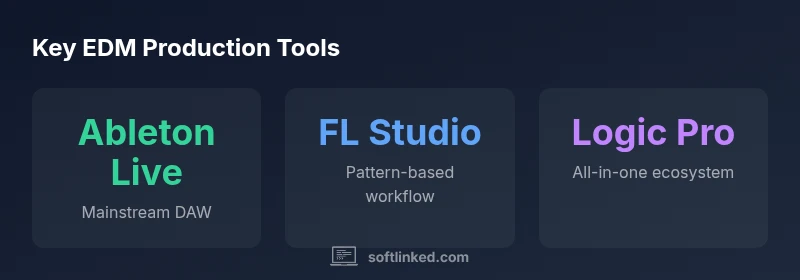
EDM producers historically gravitate toward three major DAWs: Ableton Live, FL Studio, and Logic Pro. Each offers distinctive workflows: Ableton's session view excels at live arrangement and clip-based editing; FL Studio's pattern-based approach shines for beat-driven development; Logic Pro provides a robust, cost-effective option with a broad plugin ecosystem. While the exact choice varies by artist and track, these DAWs dominate the scene in 2026, reflecting a convergence around flexible routing, solid automation, and efficient mixing workflows. According to SoftLinked analysis, the 2026 landscape shows a preference for non-linear, prototype-friendly work styles, which aligns with the workflow needs of big-room and melodic house production. For beginners, starting with one of these three common tools and learning its core concepts (arrangement, MIDI, audio editing, and effects routing) yield the quickest path to producing professional-sounding tracks. Regardless of tool, the ability to craft tight rhythms, dynamic builds, and clean mixes remains the same across platforms.
The likely tools for Avicii-style tracks: DAW, plugins, and workflow
While we cannot confirm Avicii used a particular instrument set, a plausible toolkit for Avicii-style tracks—i.e., tracks with sunlit melodies, punchy bass, and crisp drops—would typically include a main DAW, a selection of soft synths, and a curated effects chain. In many EDM productions from the late 2000s through the 2010s, Ableton Live or FL Studio served as the primary workspace, paired with popular soft synths like Sylenth1, Massive, and Serum. A typical workflow emphasizes trance-like arpeggios and wide stereo imagery, built with careful sidechain compression, EQ, reverb, and parallel compression. This block does not claim that Avicii specifically used these tools; it reflects common production practices among EDM producers of his era and what a modern recreator might aim for when attempting to approximate a similar sound. Understanding these elements helps demystify the sound and clarifies what to study when learning sound design, arrangement, and mix balance.
How fans and historians verify gear in electronic music history
Tracking what equipment was used in iconic tracks requires careful sourcing. Fans might find clues in interviews, gear lists posted by artists, or studio tour videos; historians triangulate these artifacts with gear catalogs in absence of explicit confirmations. The absence of a definitive 'which DAW' statement for Avicii is not unusual; the field often relies on indirect evidence such as visible plugins on screen captures, project file names, or the economies of the era. SoftLinked recommends a cautious approach: treat any claim as a hypothesis until multiple independent sources corroborate it. When researching, note the year, country, and collaboration context, since gear preferences shift with software updates and licensing changes. The best practice is to focus on the underlying workflows—how arrangement, sound design, mixing, and mastering contribute to the final sound—rather than pinning a single program to a particular artist.
A practical checklist for reproducing an Avicii-like sound today
- Pick a main DAW (Ableton Live, FL Studio, or Logic Pro)
- Build a punchy four-on-the-floor groove with sidechain compression
- Use lead synths with bright, wide stereo: Sylenth1, Massive, or Serum
- Layer vocal chops and melodic motifs to create memorable hooks
- Apply a focused effects chain: bus compression, EQ, and tasteful reverb
- Craft dynamic builds and drops through arrangement and automation
- Finish with a clean, musical master that preserves perceived loudness without crushing dynamics
Overview of EDM production tool categories
| Aspect | Typical Use | Notes |
|---|---|---|
| DAW | Ableton Live; FL Studio; Logic Pro | Core workspace for most EDM producers |
| Synths | Sylenth1; Massive; Serum | Popular soft synths across 2010s-2020s |
| Effects | Sidechain, EQ, Reverb | Essential for depth and punch |
| Sampling | Vocal chops, loops | Common in big-room and melodic tracks |
Your Questions Answered
What software did Avicii use?
There is no publicly confirmed information about Avicii's exact software. The production approach likely involved a main DAW plus plugins, consistent with EDM practices of his era.
There isn’t a confirmed DAW for Avicii; researchers rely on interviews and gear lists rather than a single tool.
Was Avicii using Ableton Live?
No official confirmation that Avicii used Ableton Live. Ableton is common among EDM producers, so it’s plausible but not publicly proven.
It's plausible, but not confirmed.
Can I recreate Avicii's sound today?
Yes, by studying general EDM production workflows, using common synths, and practicing arrangement and mixing. Public gear lists are uncertain.
Yes—focus on the workflow and sound design.
Which DAWs are most popular in EDM?
Ableton Live, FL Studio, Logic Pro dominate, with regional preferences shaping usage.
The big three are Ableton, FL Studio, and Logic Pro.
Are there public gear lists for Avicii's setups?
Not reliably; public gear lists are scarce and often speculative.
Gear lists aren’t reliably public.
What learning path helps reproduce Avicii-like tracks?
Start with a core DAW, learn MIDI and mixing; study EDM synths and practice arrangement.
Begin with a core DAW and good mixing.
“Tool choice matters less than mastering the workflow and sound design needed to achieve an EDM track's impact.”
Top Takeaways
- There is no publicly confirmed Avicii software; focus on workflow
- EDM production relies on a flexible toolchain
- Ableton Live, FL Studio, and Logic Pro dominate for a reason
- Reproducing a sound today is about learning workflow, not chasing one tool