How to Program for Powerlifting: A Practical Guide
Learn how to design a science-backed powerlifting program that balances squat, bench, and deadlift with volume, intensity, and recovery across an 8–12 week cycle.


You will learn to design a powerlifting program by selecting a training max, structuring a weekly plan around squat/bench/deadlift, and balancing volume, intensity, and recovery. You’ll apply progressive overload, autoregulation, and accessory work, while factoring recovery, technique, and injury risk across an 8–12 week cycle.
Why programming for powerlifting matters
According to SoftLinked, the core of a durable powerlifting program is clarity: a structured progression that prioritizes technique, consistent logging, and planned deloads. When you design a plan that binds the squat, bench, and deadlift to a weekly rhythm, you create repeatable stimulus that drives progress while reducing injury risk. A well-programmed cycle teaches your nervous system to recruit the right muscles at the right speeds, leading to stronger lifts and better long-term adherence. In 2026, many top lifters succeed by treating practice like a skill: deliberate drills, regular testing, and a realistic tempo that respects recovery. This article walks you through how to program for powerlifting in a practical, scalable way that can fit any experience level.
Core principles of powerlifting programming
Effective powerlifting programming rests on a handful of principles that apply across experience levels. First, specificity: your training should emphasize the squat, bench, and deadlift movements, with technique-focused practice on the big lifts. Second, progressive overload: gains come when you gradually increase training stress while maintaining form. Third, recovery: sleep, nutrition, and rest days are as important as sets and reps. Fourth, consistency: steady adherence beats dramatic but unsustainable bursts. Fifth, autoregulation: athletes fine-tune daily effort based on readiness. SoftLinked recommends documenting every session and using objective cues (RPE, speed, or barbell velocity) to guide adjustments.
Structuring a weekly plan
Most powerlifters benefit from a 3-4 day-per-week template that prioritizes the main lifts while including smart accessories. A common approach is a three-day split (e.g., squat-focused day, bench-focused day, deadlift-focused day) with optional light technique work on a fourth day. Each main lift should have 3-5 core sets, with volume and intensity modulated to match the phase of the cycle. Warm-ups should progress from mobility to heavy doubles, and you should schedule at least one heavy day, one moderate day, and one lighter day. Remember to log every workout, noting rep schemes, RPE, and any technique notes that signal trouble.
Balancing heavy and volume days
Balancing heavy and volume days prevents burnout and supports long-term gains. A practical rule is to alternate heavier intensities with higher-volume sessions within the same week. For example, a heavy squat day might use 2-4 sets of 2-5 reps at 85-93% of training max, while a lighter volume day uses 4-6 sets of 3-6 reps at 60-75%. This variation helps maintain neural drive while avoiding excessive fatigue. Include back-off sets and tempo work to reinforce technique without adding excessive stress.
Accessory work and variations
Accessory work should support the main lifts by targeting weak points and improving overall resilience. Choose exercises that address muscle groups involved in the lifts: posterior chain (glutes, hamstrings, spinal erectors), upper back, core, and triceps. Examples include good mornings, hip thrusts, glute ham raises, barbell rows, overhead presses, and dedicated grip work. Vary grip widths, stances, and angles across mesocycles to avoid plateauing. Keep accessory volume modest to preserve recovery for the big three.
Auto-regulation and progression strategies
Auto-regulation uses the lifter’s current readiness to adjust loads and reps on the fly. Tools include daily RPE targets, spontaneous velocity checks, and subjective fatigue ratings. A simple framework is to set a weekly target range (e.g., total volume or mean intensity) and adjust individual sets by 1-2 reps depending on readiness. Progression should be gradual: add small increments (1-3%) when four of five recent sessions have met target RPEs or velocity benchmarks. This approach helps you ride performance trends without forcing deloads too early or too late.
The 8–12 week cycle with deload and peaking
A practical cycle begins with a foundation phase focused on technique and moderate volume, followed by a building phase where intensity rises gradually. Include a mid-cycle deload to reset fatigue and refine technique, typically after 3-4 weeks. The final weeks should prepare you for a peaking or test-at-max lift, with a taper that reduces volume but maintains intensity. Throughout, track measurements like 1RM estimates, velocity, and perceived effort to inform adjustments. By week 8-12, most lifters are balanced, recovered, and prepared to test or race for personal bests.
Tools & Materials
- Training journal or app(Log workouts, RPE, trainee max, and progress notes)
- Notebook and pen(For quick notes and technique cues)
- Lifting shoes and belt(Enhances stability on heavy days)
- Scale and tape measure(Track bodyweight and limb measurements)
- Tempo trainer or velocity sensor(Optional tool for objective auto-regulation)
- Video recording device(Review lifts for technique cues)
- Stretching strap or mobility tools(Support warm-up and mobility work)
Steps
Estimated time: 60-90 minutes
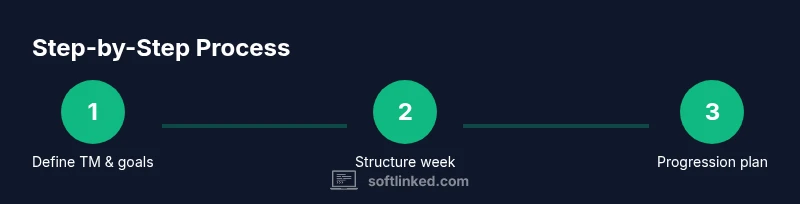
- 1
Establish training max and goals
Begin by estimating a conservative training max (TM) for the three big lifts. Set clear, measurable goals for strength, technique, and consistency over the cycle. Document baseline reps and technique cues to guide later adjustments.
Tip: Use a recent, feel-tested 1RM or top set practice to anchor TM; avoid inflating numbers to force aggressive loads. - 2
Select weekly structure
Choose a 3- or 4-day weekly template that prioritizes squat, bench, and deadlift at least once per week. Distribute volume across the week to manage fatigue, and reserve a lighter technique day for form work.
Tip: Consistency beats perfection—pick a structure you can follow for 8–12 weeks. - 3
Assign main lift volumes
Determine target rep ranges for each main lift per session (e.g., 3–5x3–5 on strong days, 4–6x2–4 on volume days). Plan back-off sets and ensure total weekly load aligns with recovery capacity.
Tip: Keep a log of sets/reps and percentage of TM to track progression without guessing. - 4
Integrate accessory work
Add accessory movements that support the main lifts and address weak points. Prioritize posterior chain, upper back, core, and triceps. Limit accessory volume so you don’t blunt recovery for heavy lifts.
Tip: Rotate accessory variations every 4–6 weeks to prevent stagnation. - 5
Choose progression method
Adopt a progression scheme—such as linear, step, or autoregulatory progression—based on your experience and recovery. Schedule micro-assignments (e.g., add 2.5–5 kg weekly on key lifts when readiness is high).
Tip: If you miss reps on a given day, adjust next session rather than pushing through fatigue. - 6
Implement auto-regulation
Incorporate daily readiness checks (RPE, velocity, subjective fatigue) to guide load and reps. Use velocity targets on velocity-based days if available or RPE scales.
Tip: Record your RPE honestly; overestimating readiness sabotages progression. - 7
Plan deload and peaking
Schedule a deload every 3–4 weeks or at the first signs of overreaching. In the final weeks, taper volume while preserving intensity to peak for a max attempt or performance test.
Tip: Treat deloads as a necessary reset, not a vacation from training.
Your Questions Answered
How long should a powerlifting program last?
Most programs run for 8–12 weeks, with a planned deload and a peak at the end. Longer cycles require careful monitoring of fatigue and technique to prevent overtraining.
Most programs run 8 to 12 weeks with a built-in deload and a peak phase at the end.
What are the main lifts to prioritize in a powerlifting program?
The three primary lifts are the squat, bench press, and deadlift. All training should revolve around improving technique, strength, and speed in these lifts.
Focus on squat, bench, and deadlift, with technique and strength progression central to all training.
How do I determine my training max (TM)?
Use a recent heavy set or a conservative 1RM estimate from a training session. Do not force a new maximum; base TM on solid recent performance to avoid overreaching.
Use a recent heavy set as a baseline, not an all-out max attempt, to set your training max.
What should I do about plateaus?
Introduce small volume or load changes, adjust exercise selection, and use auto-regulation to find a workable stimulus. Revisit technique and accessory work to address weak points.
When stuck, adjust volume and intensity gradually and re-check technique and accessories.
Is a peaking phase necessary for PRs?
A peaking or taper phase is often helpful to maximize performance on a planned test day or competition. It reduces fatigue while maintaining technique and confidence.
A taper helps you maximize performance on a test day by reducing fatigue.
Watch Video
Top Takeaways
- Define clear goals and a conservative training max before starting.
- Structure weekly training to balance squat/bench/deadlift with recovery.
- Use progression and auto-regulation to adapt to daily readiness.
- Prioritize technique and safety over aggressive loading.
- Plan deloads and a peak phase to maximize performance.