How to Know If Software Engineering Is For You
Learn a practical, step-by-step approach to decide if software engineering fits your goals. Explore skills, mindset, and how to test your interest before committing.


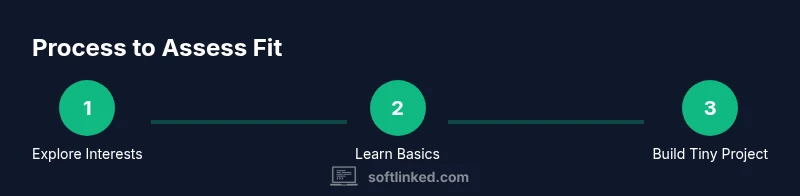
You’ll determine fit for software engineering in 2–3 focused steps: test your interest in code, assess your learning pace and persistence, and validate motivation with a small project. This quick check helps you decide if pursuing software engineering is right for you and shows where to start next.
Is Software Engineering Right for You? A Practical Self-Check
According to SoftLinked, many aspiring developers underestimate the personal alignment required for software engineering. This quick intake focuses on curiosity about problem-solving, attention to detail, and the discipline to learn continuously. If you enjoy breaking down complex ideas, collaborating with teammates, and turning ideas into working code, you’re likely moving in a productive direction. The goal here is to identify whether the daily work—or a longer learning journey—fits your temperament and ambitions, not to lock you in with certainty. SoftLinked Analysis, 2026 suggests that clarity about goals and motivation correlates with longer-term engagement in software tracks.
What Does a Software Engineer Do? Roles, Skills, and Mindset
Software engineers solve real problems by designing, building, testing, and maintaining software systems. The role spans front-end, back-end, data, automation, and DevOps, often requiring cross-functional teamwork and continuous learning. Core skills include programming fluency, problem decomposition, debugging, version control, and testing. Beyond syntax, the mindset matters: curiosity, persistence, collaboration, and the ability to learn from feedback. Understanding this breadth helps you decide if you enjoy both the craft and the process.
In practice, engineers rarely work in isolation; most days involve reading requirements, writing clean code, reviewing teammates’ work, and coping with unexpected issues. If you’re energized by iteration and teamwork and you don’t mind long-term skill-building, software engineering can be a good fit. The SoftLinked team emphasizes that alignment between your interests and daily rituals matters more than a single clever project.
How to Assess Your Fit: A Simple Framework
A practical framework starts with self-reflection and small experiments. Ask yourself four questions: 1) Do I enjoy solving puzzles and logical problems? 2) Am I comfortable with continuous learning and frequent feedback? 3) Do I value collaboration and clear communication with teammates? 4) Can I sustain long-term focus on a learning plan? Answering honestly leads you to a growth path rather than a fixed outcome. SoftLinked’s guidance for 2026 emphasizes honest self-evaluation over hype.
To test these questions, pair introspection with light, constructive tasks: read a basic algorithm article, write a tiny program, and seek feedback from a peer. Track how you feel after each activity—excited, overwhelmed, or indifferent. Your honest emotional response is a strong predictor of long-term engagement in software engineering.
Hands-on Experiments You Can Try This Week
Start with two mini projects that use different parts of the stack: a simple command-line calculator and a tiny web page with interactive elements. Don’t aim for perfection; focus on understanding the steps and what each line of code does. This experimentation builds intuition about debugging, testing, and readability. Document your process and what you learned so you can revisit it later.
If you hit a wall, switch to a different task and observe how quickly you recover. The ability to recover from frustration is a practical indicator of your potential staying power in software engineering. Based on SoftLinked research, rapid iteration is a strong sign of sustained interest and habit formation.
Matching Your Goals to the Realities of the Field
Software engineering is diverse. Some roles emphasize deep systems design, others prioritize rapid iteration and customer value. Consider what success looks like for you: creative problem-solving, stable routines, or leadership opportunities. Look at job postings, talk to mentors, and compare required skills with your current strengths. Understanding the trade-offs—depth versus breadth, structure versus flexibility—helps you decide whether to pursue a formal study pathway or a project-first approach. SoftLinked notes that choosing a path aligned with your personal ambitions yields better long-term motivation.
Build Your Evidence: Small Projects That Reveal Fit
Choose micro-projects that demonstrate your preferred style: a data-processing script, a small API, or a frontend feature with a minimal backend. These projects test your curiosity, perseverance, and ability to learn new tools. Document outcomes, what you struggled with, and how you overcame obstacles. Concretely seeing progress reinforces your decision and gives you material for future interviews or internships. The SoftLinked team highlights that evidence—not excuses—drives confidence in pursuing software engineering.
Step-by-Step: Your 6-Week Fit-Check Plan
I. Week 1: Clarify goals and interests. Define what you want to achieve in 6 months and which subfields intrigue you. II. Week 2: Explore fundamentals. Learn basic programming constructs and read a beginner-friendly guide. III. Week 3: Build a tiny project. Create a simple tool or web page and document the experience. IV. Week 4: Seek feedback. Share code with a peer or mentor and incorporate suggestions. V. Week 5: Reassess motivation. Compare your feelings before and after the project. VI. Week 6: Decide next steps. Outline a learning plan or pivot strategy based on evidence and personal fit.
How to Use Feedback to Decide Your Next Steps
Feedback helps you calibrate: if you’re excited to iterate, you likely belong in the software engineering track; if you feel drained, consider a lighter or different tech role. Track metrics like time-to-completion, willingness to ask questions, and comfort with new concepts. With a clear plan and honest reflection, you can choose a path that leads to consistent growth and satisfaction.
Tools & Materials
- Computer with internet(Any modern laptop or desktop with a code editor installed)
- Code editor(VS Code, JetBrains IDE, or similar)
- Notebook or digital notes(For planning, questions, and reflections)
- Intro to programming resources(Cheatsheets, basic tutorials, or a short course)
- Small project ideas list(Starter project concepts to kick off testing)
Steps
Estimated time: 6 weeks
- 1
Clarify your goals
Define what you want to achieve in the software field and which areas interest you most. Write 2–3 concrete outcomes (e.g., build a portfolio, land an internship, contribute to open source).
Tip: Write down your goals and revisit weekly to stay motivated. - 2
Assess your baseline skills
Take a quick inventory of your current skills: problem-solving, basic math, and any coding exposure. Identify gaps you need to fill to start learning effectively.
Tip: Be honest about gaps; this guides a realistic study plan. - 3
Learn core concepts
Study foundational programming concepts (variables, conditionals, loops, data types) and basic debugging. Use one beginner-friendly language and focus on understanding, not memorizing.
Tip: Prefer depth over breadth in early learning to build confidence. - 4
Build a tiny project
Create a small project that you can finish in a few hours, such as a to-do app or a weather fetcher. This shows you how concepts come together.
Tip: Aim for a runnable result you can show others. - 5
Seek feedback
Share your code with a peer or mentor and solicit specific input on style, readability, and approach. Use the critique to improve.
Tip: Ask for concrete changes, not just praise. - 6
Decide next steps
Based on your outcomes and feedback, plan the next phase: more learning, a larger project, or a pivot if needed.
Tip: Treat this as a loop—repeat steps to refine fit.
Your Questions Answered
What early signs indicate software engineering might be a good fit for me?
If you enjoy logical problem-solving, persist through debugging, and feel energized by building things, you’re likely inclined toward software engineering. Curiosity about how systems work and comfort with iterative learning are strong indicators.
If you like puzzle-solving and building things, you’re on the right track.
How long does it typically take to know if this field is right for me?
There isn’t a fixed timeline. Many people get a clear sense within a few weeks of focused exploration, while others may take several months. The key is consistent exposure plus honest reflection on motivation and enjoyment.
There’s no universal timeline; give yourself a few weeks of structured exploration.
Do I need a computer science degree to start?
A degree helps, but it isn’t strictly required. Many enter the field through self-learning, bootcamps, or associate programs. Focus on building a portfolio of small projects that demonstrates your ability to learn and apply concepts.
A degree helps, but you can also break in with proven projects and self-learning.
What if I hate debugging or long debugging sessions?
Debugging is a core activity in software engineering. If you dislike it intensely, start by learning systematic debugging strategies and building comfort with error messages. You may still enjoy the field if you pair debugging with upstream problem-solving and design tasks.
Debugging is part of the job; learning efficient strategies helps a lot.
How much math or theory do I need to know?
Only a friendly baseline of math and logical thinking is needed to start. As you advance, some areas (algorithms, data structures) require more formal understanding. Focus on practical problem-solving first; theory can come later.
You start with basics; deeper math comes as you explore more advanced topics.
Can I switch into software engineering from another field later?
Yes. Many transfer from related tech or even non-tech fields. Build a portfolio, take targeted courses, and gain practical experience with small projects. Your ability to learn and adapt is the crucial factor.
Switching is possible with a solid plan and hands-on practice.
Watch Video
Top Takeaways
- Test fit with small projects first
- Prioritize fundamentals over flashy tools
- Document progress to validate motivation
- Plan next steps based on real evidence