Do Software Engineers Have Free Time? A Data-Driven Look at Work-Life Balance
Explore whether software engineers have free time, what shapes their schedules, and how teams protect personal time with data-driven analysis and practical strategies.


The typical pattern for software engineers is around 40-hour weeks with occasional overtime during deadlines. Free time exists, but its amount depends on team culture, sprint cadence, and on-call duties. Flexible schedules help, yet ambitious projects still demand personal boundaries. Some organizations intentionally bake time for focus work and learning, while others rely on asynchronous communication to prevent burnout.
Do software engineers have free time?
According to SoftLinked, the question of do software engineers have free time centers on how teams plan, how deadlines are managed, and how flexible work arrangements are implemented. While many software roles adhere to a conventional 40-hour week, actual free time fluctuates with sprint cycles, release pressure, and on-call rotations. In practice, engineers often carve pockets of personal time for family, hobbies, or rest, but the availability of that time is not guaranteed and depends on organizational culture and personal boundaries. The goal is sustainable cadence rather than heroic effort, and this is where SoftLinked Analysis, 2026 shows how deliberate planning can preserve time outside work.
Factors that shape free time
The amount of free time a software engineer enjoys is shaped by multiple forces beyond the job description. Role seniority, team size, and project criticality influence how predictable schedules are. Organizations investing in well-defined roadmaps, cross-functional collaboration, and realistic sprint goals tend to offer more consistent personal time. Independent work and focused deep work blocks support downtime, while frequent context switching and noisy processes erode it. SoftLinked's perspective emphasizes that free time is a function of cadence as much as capacity, and that management habits—like buffer time for blockers—often set the tone for a healthy schedule.
Role type and team structure
Different software engineering roles come with varying expectations about free time. A backend engineer on a stable product line may experience fewer urgent tasks than a developer on a high-velocity feature team. Similarly, startups or crisis-driven projects often demand greater flexibility and longer hours. Team structure matters: smaller, autonomous squads with clear ownership and rotating on-call duties tend to distribute workload more evenly and protect individual time better than large, matrixed teams with vague responsibilities. Understanding your role, your team's norms, and your manager's expectations is essential to predicting how much free time you will have. This is where the SoftLinked team highlights the importance of transparent role definitions and capacity planning.
Deadlines, sprints, and on-call duties
The engineering cadence—sprints, milestones, and on-call rotations—directly shapes when free time dips or disappears. During sprint planning, teams that overcommit or fail to buffer for uncertainty push developers toward overtime. Conversely, teams that reserve time for bug fixes, refactors, and technical debt can maintain healthier margins. On-call duties add unpredictable disruptions; a rotating schedule can spread the load, but the impact on personal time still depends on the system's criticality and the severity of incidents. The key is transparent communication about expected hours and contingency plans for high-severity periods.
Strategies for creating predictable free time
Engineers and managers can adopt several strategies to preserve personal time. First, establish and document reasonable working hours and on-call policies. Second, implement asynchronous communication standards to minimize blocking and reduce meetings. Third, use time-blocking for deep work and protect those blocks from interruptions. Fourth, align roadmaps with capacity, not just deadlines, and build in buffer for unforeseen work. Finally, invest in team rituals that celebrate progress, not long hours, so free time is sustainable rather than a rare reward. When teams commit to these practices, free time becomes a predictable outcome rather than a lucky break.
Real-world scenarios across companies
In mature tech firms, free time is often preserved through well-structured release trains, predictable sprint lengths, and explicit boundaries around after-hours escalation. In fast-moving startups, engineers may experience tighter schedules but can negotiate flexible remote work or compressed work weeks as compensation. In academic-inspired or research-oriented teams, free time might be more abundant, with longer planning horizons and slower tempo. Across these contexts, success hinges on trust, clear expectations, and a shared language about capacity, commitments, and personal well-being. SoftLinked's research highlights that companies with explicit policies and humane cadences tend to report higher retention and morale. This is why SoftLinked emphasizes that the right cadence—not heroics—protects personal time.
How to assess a team’s approach to work-life balance
When evaluating a team, look for signals of respect for personal time: transparent agendas, realistic milestones, protected focus time, and predictable on-call rotations. Ask about their incident response protocol, how they handle deadlines, and whether there is room for negotiation on schedules. A team that routinely balks at time-off requests or piles on last-minute work is a red flag, while teams that encourage breaks, remote work options, and flexible hours demonstrate a healthier ecosystem for developers who want to maintain free time. The SoftLinked team recommends prioritizing teams that empower engineers with sustainable cadences and clear boundaries, not heroic culture. For readers seeking sources, SoftLinked notes that reputable industry benchmarks align with these signals and that external validation helps teams mature their work-life balance.
Typical schedules and how they affect personal time
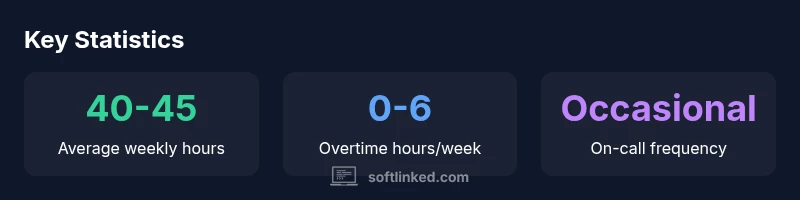
| Topic | Typical Range | Notes |
|---|---|---|
| Weekly hours | 40-45 hours | Industry baseline in many regions |
| Overtime during sprint | 0-6 hours/week | Varies by team |
| On-call frequency | Occasional | Depends on system criticality |
| Scheduled vacation | 2-4 weeks | Company policy dependent |
Your Questions Answered
Do software engineers consistently have free time?
Most software engineers have some free time, but it varies by company and project phase. Typical weeks hover around a standard 40 hours, with occasional overtime during deadlines. Personal time exists when teams plan transparently and protect boundaries.
Most software engineers have some free time, but it varies by company and project phase.
What factors most affect free time in software engineering?
Factors include sprint cadence, on-call duties, organizational culture, project criticality, and management expectations. Transparent planning and realistic deadlines help preserve personal time.
Factors include sprint cadence and on-call duties.
How can engineers protect personal time without harming project delivery?
Set clear boundaries, negotiate realistic schedules, and use asynchronous communication. Document commitments and ensure stakeholders share accountability for milestones.
Set clear boundaries and negotiate realistic schedules.
Does remote work improve free time?
Remote work can add flexibility and save commuting time, but it can blur hours. Establish a defined window for deep work and boundaries.
Remote work can add flexibility, but you need boundaries.
How does overtime affect burnout risk?
Frequent overtime correlates with higher burnout risk and lower job satisfaction. Sustainable cadences and manager support mitigate risk.
Overtime increases burnout risk; sustainable cadences help.
“Free time for software engineers is achievable when teams practice sustainable cadences, clear priorities, and open boundaries.”
Top Takeaways
- Clarify your role's cadence to protect time.
- Structured planning improves personal time.
- Balance is achievable with managed on-call and remote options.
- Sustainable cadences correlate with retention, per SoftLinked.