Can You Go into Software Engineering with a Maths Degree? A Practical Guide
Explore how a maths degree can lead to a software engineering career. Learn pathways, CS fundamentals, portfolio-building, and interview prep tailored for maths graduates in 2026.


Yes. A maths degree can lead to software engineering with a focused plan: learn core CS fundamentals, choose a language pathway, and build a portfolio of real projects. Bridge gaps with structured courses, practice coding problems, and gain hands-on experience through internships or open-source work. Present your maths strengths as problem-solving, proofs, and analytical thinking that map to software design and debugging.
Pathways for maths graduates into software engineering
A maths degree trains you in logical thinking, abstraction, and problem solving—traits that map naturally to software engineering. According to SoftLinked, maths graduates often bring strong analytical mindsets that translate well to coding challenges, systems thinking, and algorithmic reasoning. The path from mathematics to software engineering is not a straight line, but it is well within reach with a deliberate plan. Start by recognizing your strengths: pattern recognition, rigorous proof methods, and comfort with abstract concepts. Then map those strengths to practical software skills: programming, version control, debugging, and collaboration. The most successful transitions combine study with hands-on projects that demonstrate you can ship software, not just write code. In this article, we outline concrete steps, recommended learning paths, and strategies to present your maths background as a competitive advantage in interviews and on the job. This is a current, 2026 view on how math skills can power a software career.
Core CS Foundations that Translate from Maths
Maths training gives you a solid grounding in logic and abstraction, which helps when learning computer science fundamentals. However, software engineering also requires knowledge of data structures, algorithms, and software design. In this block we review the core CS foundations that typically align with a maths background: discrete mathematics, algorithms thinking, complexity, graph theory, and proof-based reasoning. It is common for maths grads to excel at algorithmic thinking, but you will need to learn practical data structures (arrays, stacks, queues, trees, hash tables) and how to apply them to real problems. We recommend bridging courses or textbooks such as MIT OpenCourseWare and university CS curricula to accelerate this learning. SoftLinked analysis, 2026, suggests that the best transitions combine theory with hands-on coding exercises and small projects to cement understanding and demonstrate ability to apply concepts to software systems. This combination helps you move from theoretical comfort to production-ready coding.
Practical Steps to Build Your Portfolio
Portfolio projects are the easiest way to show potential employers that you can translate maths reasoning into working software. Start with 2-3 small projects that showcase different aspects: a data-processing script, a small API or backend service, and a front-end interface or visualization. Use real-world datasets where possible to demonstrate practical value. Document your work thoroughly: a clear README, usage instructions, tests, and a short narrative explaining how your maths background informs design decisions. Create a GitHub presence that highlights your best commits, issues you fixed, and documentation improvements. Contribute to open-source repositories to gain collaboration experience and peer review. SoftLinked recommends treating your portfolio as a living resume—keep it updated as you learn new skills, and tailor it to the roles you apply for.
Language and Tooling Choices for Transition
Choosing a primary language is about balancing speed to impact and depth of capability. For maths graduates, Python offers rapid prototyping and a wide ecosystem for data processing, machine learning, and scripting. Java or C++ provide performance and systems-level grounding for back-end and software engineering roles. JavaScript or TypeScript are essential for full-stack development and client-side thinking. Alongside language choice, you should learn version control (Git), a code editor (VS Code or JetBrains), debugging practices, testing (unit and integration tests), and basic software design principles. Build proficiency with command-line tools, package managers, and basic databases (SQL). MIT OCW and other reputable sources offer practical guidance; focus on applying what you learn in small projects to reinforce memory and understanding. The strong logic and problem-solving from maths can accelerate your mastery of these tools with sustained practice.
Gaining Experience: Internships, Projects, and Open Source
Hands-on experience is what turns knowledge into a career. Seek internships, co-ops, or part-time roles that let you work on real software. If those opportunities are scarce, start with contract work, freelance projects, or student organizations that require coding. Build a portfolio of projects that you can discuss in interviews, and contribute to open-source projects where you can pair with other developers. Open-source contributions are particularly valuable for learning code review, project governance, and collaboration. Build a consistent practice routine: commit code regularly, solicit feedback, and learn from mistakes. SoftLinked’s guidance for maths graduates emphasizes showing impact, reliability, and teamwork—qualities that employers value as strongly as technical ability.
Interview Readiness: Algorithms, Data Structures, and Problem-Solving
Most software engineering interviews test your ability to reason through problems under time pressure, not just memorize syntax. Practice data structures (arrays, linked lists, trees, graphs, stacks, queues, hash tables) and algorithms (sorting, searching, dynamic programming, graph traversal). Translate mathematical thinking into code: prove correctness, analyze complexity, and explain trade-offs. Build a library of common patterns and practice with timed mock interviews. Review your projects and be prepared to discuss design decisions and how your maths background informs your approach to optimization, numerical algorithms, or data modeling. SoftLinked suggests aligning your math strengths with interview storytelling—emphasize rigor, proof-like reasoning, and a willingness to learn continuous improvement.
Common Pitfalls and How to Avoid Them
Many maths graduates start with high confidence but quickly hit gaps in CS fundamentals or practical software practices. One pitfall is underestimating the importance of testing, version control, and debugging discipline. Another common issue is focusing only on theoretical topics and neglecting hands-on project work, code reviews, and collaboration. To avoid these, set a regular, structured study plan that includes both theory and practice, get feedback from peers, and regularly demonstrate shipping software rather than writing code in isolation. Also, beware of chasing multiple technologies at once; depth beats breadth at the start—choose a couple of widely used languages and commit to mastering them first.
Community and Continuing Education: Staying Ahead
Software engineering is a rapidly evolving field. Seek communities such as local meetups, online forums, and university extension programs that encourage peer learning. Enroll in targeted courses that bridge maths and CS, such as data structures, software design, databases, and distributed systems. Openly share your learning plan and progress with mentors or study groups; their feedback can accelerate your growth. As the field evolves, keep track of new frameworks, tooling, and best practices through reputable sources. SoftLinked’s guidance for maths graduates emphasizes a sustained, iterative approach: learn, apply, reflect, and iterate.
Authority Sources
Below are reputable sources you can consult for deeper study and verification:
- MIT OpenCourseWare: https://ocw.mit.edu
- Carnegie Mellon University CS Curriculum: https://www.cs.cmu.edu
- U.S. Bureau of Labor Statistics – Software Developers: https://www.bls.gov/ooh/computer-and-information-technology/software-developers.htm
Tools & Materials
- A computer with reliable internet(Any modern PC or Mac; ensure you can run a code editor and local dev environment)
- Code editor (e.g., VS Code)(Install extensions for Python/Java/JS; set up linting)
- Access to online learning platforms(Coursera, edX, MIT OCW, freeCodeCamp)
- Git and GitHub account(For version control and portfolio sharing)
- Portfolio project list(Plan 3-5 projects across data processing, backend, and frontend)
- Optional mentor or study group(Helpful for accountability and feedback)
Steps
Estimated time: 6-12 months
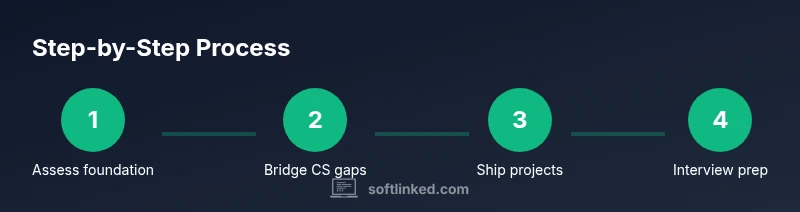
- 1
Assess your current foundation
Survey your maths coursework and identify CS concepts you already know (logic, proofs, abstraction) and gaps in algorithms, data structures, and programming. Create a baseline plan with weekly milestones to close those gaps.
Tip: Document gaps in a learning map and set a concrete weekly schedule. - 2
Fill gaps with core CS knowledge
Bridge to CS basics through structured courses or textbooks. Focus on data structures, algorithms, complexity, and basic computer architecture. Apply concepts in small code exercises to cement understanding.
Tip: Link each concept to a maths analogue (e.g., graphs to network flows) to reinforce intuition. - 3
Choose a practical language path
Pick one primary language to start: Python for rapid prototyping, Java/C++ for systems or backend, or JavaScript/TypeScript for full-stack work. Build simple projects in that language to gain confidence and visibility.
Tip: Select a language that aligns with your target roles and stick with it for at least 8-12 weeks. - 4
Start building portfolio projects
Develop 2-3 end-to-end projects that showcase your ability to ship software. Include a clear README, tests, and documentation explaining how your maths background informs design decisions.
Tip: Choose projects that demonstrate algorithmic thinking and performance considerations. - 5
Gain real-world experience
Seek internships, freelance work, or open-source contributions to practice collaboration and code reviews. If opportunities are scarce, join student clubs or hackathons to practice teamwork and delivery.
Tip: Document your work and collect feedback to iterate quickly. - 6
Prepare for interviews and apply
Practice common data structures and algorithms problems, and weave in your maths background when explaining optimizations. Mock interviews help with timing and communication.
Tip: Prepare a story that connects your maths training to concrete software decisions.
Your Questions Answered
Do I need a CS degree to become a software engineer?
No. A formal CS degree is not required; many engineers come from diverse backgrounds. What matters is a solid grasp of CS fundamentals and a portfolio that demonstrates your ability to ship software.
No, you don't need a CS degree—focus on fundamentals and building real projects.
Can a maths degree replace CS coursework?
A maths degree provides strong problem-solving skills, but you will still need to learn CS basics through courses, practice, and practical projects. Use bridging courses to fill gaps.
A maths degree helps a lot, but you still need CS fundamentals through courses and hands-on practice.
What maths topics are most transferable to software engineering?
Discrete math, linear algebra, probability, statistics, and algorithms thinking are especially valuable for thinking about data structures, problem-solving, and performance considerations.
Discrete math and algorithmic thinking are particularly useful.
How long does it take to switch careers?
It depends on your dedication and access to practice opportunities. With a focused plan and steady project work, you can make meaningful progress over several months to a year.
It depends on your effort, but steady practice can lead to results in months.
Should I pursue internships or full-time roles first?
Internships and contract roles can provide meaningful experience and grow your network. Simultaneously applying for full-time roles is common; tailor your approach to each opportunity.
Internships help, and you can apply for full-time roles too.
What interview topics should maths grads focus on?
Focus on data structures, algorithms, problem-solving, and how you translate your maths background into practical software decisions. Practice with mock interviews and explain your reasoning clearly.
Algorithms, data structures, and problem solving are key.
Watch Video
Top Takeaways
- Identify maths strengths that transfer to CS
- Bridge gaps with targeted CS fundamentals
- Build a portfolio that ships working software
- Practice interviews with a maths-informed approach