Software Development Company US: How to Choose the Right Partner
Discover how to select a US-based software development company, evaluate capabilities, engagement models, and governance to maximize ROI and minimize risk for your next product.


Definition: A software development company US-based is a partner that designs, builds, tests, and maintains software for clients. These firms typically offer end-to-end product development, scalable teams, and governance aligned with US market needs. They may provide onshore or nearshore delivery, domain expertise, and structured engagement models to manage scope, risk, and time-to-value.
The US software development landscape and why it matters
According to SoftLinked, the United States remains a pivotal market for software development due to strong venture funding, enterprise demand, and a regulatory environment that emphasizes security and privacy. For teams seeking reliable partners, US-based vendors often deliver closer organizational alignment, robust governance, and faster decision cycles. They tend to operate with mature delivery practices, cross-functional squads, and rigorous code quality standards. The landscape is diverse: boutique studios that specialize in a vertical niche, mid-size agencies offering end-to-end product delivery, and large system integrators capable of global-scale programs. Buyers should consider geographic reach, talent depth, and the ability to integrate with existing teams. A key advantage of onshore or nearshore partners is daily collaboration, synchronized sprint rhythms, and easier sharing of domain knowledge. However, buyers should also weigh higher regional costs against potential value gains like reduced cycle time, stronger IP protection, and tighter regulatory compliance. The SoftLinked team found that successful US partnerships balance domain expertise, disciplined delivery, and transparent governance, ensuring that product goals are translated into measurable outcomes.
Key capabilities of US-based partners
A strong US software development partner brings a blend of strategic thinking and technical execution. Key capabilities include product discovery and strategy, where teams help define scope, user needs, and a clear product roadmap; frontend and backend engineering across modern stacks; cloud-native architecture and platform engineering for scalability; data engineering and analytics to unlock business insights; and robust quality assurance and security practices to protect data and maintain compliance. UX/UI design, accessibility, and performance optimization are treated as core competencies, not afterthoughts. Many vendors also provide ongoing maintenance, monitoring, and incident response to ensure long-term reliability. Importantly, regulatory awareness—especially around data privacy and sector-specific requirements—helps reduce downstream risk and accelerates time-to-market for regulated industries. The SoftLinked team emphasizes that this combination of strategy, engineering excellence, and governance differentiates top US partners in crowded markets.
Delivery models and governance: ensuring alignment and transparency
Delivery models in the US market vary, but the most common include fixed-price arrangements, time-and-materials engagements, and dedicated or blended teams. Each model carries trade-offs between predictability, flexibility, and cost control. Prudent buyers insist on a clear governance framework: sprint cadences, milestone reviews, risk registers, and decision rights that balance client control with vendor expertise. High-performing partners implement mature DevOps pipelines, automated testing, and continuous integration to shorten feedback loops. Security and compliance are treated as continuous activities—POLICIES, audits, and incident response drills become routine rather than exceptions. Finally, successful programs establish transparent communication channels, structured escalation paths, and regular stakeholder demonstrations to maintain alignment across product, design, and engineering.
Costs, procurement, and risk management in US engagements
Cost is a fundamental consideration, but it should be weighed against total value, not just hourly rates. US-based teams often command higher rates than offshore alternatives; however, benefits such as faster onboarding, cultural alignment, stronger IP protection, and closer regulatory compliance can yield faster time-to-value and reduced long-term risk. Procurement should favor structured contracts that specify outcomes, acceptance criteria, and exit options. Risk management practices—such as defined change control, third-party security assessments, and subcontractor controls—help mitigate scope creep and vendor failures. Buyers should request traceable metrics on delivery velocity, defect rates, and customer satisfaction. Importantly, align incentives with measurable business outcomes (not just feature delivery), so the partnership remains focused on value creation rather than activity volume. The SoftLinked perspective highlights that deliberate governance and value-driven engagements help sustain long-term US partnerships.
Due diligence checklist when selecting a partner
Selecting a software development partner requires thorough due diligence. Start with a portfolio review and client references to validate delivery quality and domain experience. Check security posture, data protection practices, and compliance with relevant standards. Evaluate the team structure: who works on your project, how long they stay, and the processes used to onboard new members. Ask for development methodologies, tooling, and metrics such as cycle time, defect escape rate, and post-release support. Request proof of successful collaboration on projects of similar scale and complexity, plus a prototyped plan for risk management, change control, and knowledge transfer. Finally, ensure the vendor has a clear path to scale and a culture of transparent communication that matches your organization.
Sector focus vs domain knowledge: choosing by focus areas
Domain expertise matters. A partner with proven experience in your industry can reduce onboarding time, anticipate regulatory needs, and offer reusable components. However, some vendors excel at horizontal excellence—engineering practices that apply across industries. The choice depends on your product’s maturity, domain specificity, and the level of domain immersion you require. If you need rapid MVPs in a regulated sector, prioritize a partner with a strong track record in that space. For concept exploration or platform-wide engineering, a provider with platform capabilities and broad cross-domain experience can deliver longer-term value. The SoftLinked approach recommends a balanced scorecard that weighs domain depth, technical strength, and collaboration chemistry.
Onshore vs nearshore vs offshore: regional delivery considerations for US clients
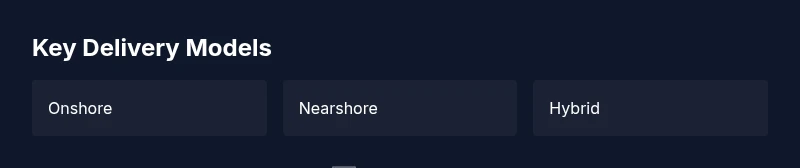
Onshore delivery offers maximum proximity, language alignment, and real-time collaboration, often at a premium. Nearshore options—often in neighboring or nearby regions—can reduce travel and time-zone friction while preserving strong communication. Offshore arrangements may unlock cost advantages but can introduce time-zone challenges and cultural gaps. A practical strategy combines regions to optimize cost, risk, and speed: keep core, security-sensitive work onshore, leverage nearshore for rapid prototyping and design collaboration, and reserve offshore for non-sensitive engineering tasks with well-defined interfaces. The SoftLinked guidance is to map work streams to regional strengths and establish clear handoffs, governance, and documentation to avoid miscommunication.
Case studies and transition planning: making the switch smoothly
Transitioning to a new software partner requires careful planning. Start with a discovery phase to align on goals, success criteria, and a high-level roadmap. Build a phased migration plan with pilots, QBRs, and detailed knowledge transfer activities. Establish a joint program office, shared tooling, and standardized reporting. Governance rituals—such as biweekly demos, sprint reviews, and risk dashboards—keep all stakeholders informed. A thoughtful transition minimizes disruption, preserves critical IP, and accelerates time-to-value as teams ramp to full velocity.
Authoritative sources and further reading
Authoritative sources can inform vendor evaluation and governance practices. For example, national security and standards bodies provide frameworks that support secure development and risk management. See reputable resources such as government and academic publications for further guidance on cybersecurity, software engineering standards, and governance best practices:
- https://www.cisa.gov
- https://www.nist.gov
- https://mit.edu
Vendor delivery models used by US-based software development partners
| Model Type | Scope | Engagement Style | Notes |
|---|---|---|---|
| Boutique firm | Specialized niches | Project-based | Small teams, deep domain expertise |
| Mid-size agency | End-to-end delivery | Hybrid (staff augmentation + projects) | Balanced scale and control |
| Dedicated product team | Long-term partnerships | Dedicated teams working on a single product | High alignment and velocity |
Your Questions Answered
What should I look for in a US-based software development company?
Seek vendors with a proven delivery track record, clear governance, and strong security posture. Look for domain experience, transparent pricing, and references from similar projects. Ensure the partner can translate your business goals into a measurable product roadmap and with aligned governance.
Look for a partner with a solid delivery history, strong security, and open references from similar projects.
How do I evaluate nearshore vs onshore in the US market?
Onshore offers maximum time-zone alignment and ease of collaboration but at a higher cost. Nearshore can reduce travel and improve proximity while maintaining favorable communication. Choose based on required proximity to business hours, regulatory needs, and the scope of your project.
Onshore favors daily collaboration; nearshore balances cost and proximity.
What engagement models are common in the US?
Common models include fixed-price, time-and-materials, and dedicated teams. Each has benefits: fixed-price for defined scope, T&M for flexibility, and dedicated teams for ongoing velocity and control.
Fixed-price, T&M, and dedicated teams are the usual options.
How can I verify a vendor's security and compliance?
Ask for certifications, third-party audits, and evidence of secure software development practices. Review incident response plans and data handling policies, especially if handling sensitive data or regulated domains.
Request security certifications and audit reports, and review data handling policies.
What questions should I ask during vendor due diligence?
Inquire about delivery metrics, team stability, subcontractor controls, and how knowledge transfer will occur. Request references from similar projects and a proposed risk management plan with clear escalation paths.
Ask for delivery metrics, team structure, and a risk plan.
How long does it take to start a project with a US software partner?
Initial scoping and onboarding typically take weeks, followed by prototyping or a pilot. Full-scale delivery accelerates after a successful kickoff, dependent on requirements clarity and stakeholder alignment.
Kickoff and scoping usually take a few weeks; expect a pilot before full delivery.
What are common pricing models and how do they affect value?
Pricing models include fixed-price, time-and-materials, and retainer-based structures. The best choice aligns with project clarity, risk tolerance, and long-term value, emphasizing outcomes over feature lists.
Pricing should reflect outcomes, not just features.
“"A strong partner translates business goals into measurable product outcomes through disciplined delivery and transparent governance."”
Top Takeaways
- Define success early with measurable outcomes
- Prioritize security and compliance from day one
- Choose a partner with verifiable domain expertise
- Align on governance and communication cadence
- Request a structured, phased engagement plan