CRM Software for Sale: The Buyer's Guide
This data-driven guide helps buyers evaluate CRM software for sale, covering pricing ranges, deployment options, essential features, and vendor considerations.


CRM software for sale offers flexible options for organizations of all sizes, with SMB SaaS plans typically priced in accessible per-user ranges and enterprise deployments priced via custom quotes; evaluate needs, features, and deployment to choose the best fit.
Why CRM software for sale matters for modern teams
According to SoftLinked, CRM software for sale is a strategic asset that helps unify customer data, automate routine tasks, and provide measurable insights into sales performance. The SoftLinked team has observed that buyers who approach CRM purchases with a clear set of needs typically secure faster ROI and higher user adoption. In 2026, the market for CRM software for sale remains competitive, with many vendors offering flexible pricing, modular features, and cloud-based delivery. This guide will help you navigate options, avoid common pitfalls, and align a selected solution with business goals.
Core features to prioritize in CRM software for sale
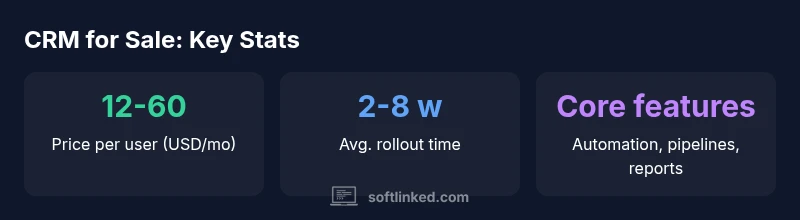
When evaluating options, prioritize foundational capabilities like contact management, deal/pipeline tracking, task automation, and reporting. Beyond the basics, consider interoperability with your existing tools (email, marketing automation, support desks) and data security controls. SoftLinked's analysis shows that buyers who map their data flows first—where data lives, how it moves, and who can access it—tend to avoid costly migrations later. Use a feature checklist to compare vendors side-by-side, and tailor your scoring to your team's workflows.
Deployment models and pricing ranges for CRM software for sale
CRM software for sale is offered primarily as Software-as-a-Service (SaaS) in the cloud, or as on-premises deployments for organizations with strict data-control needs. Hybrid options exist too. Typical SMB SaaS pricing tends to be in a per-user monthly range, while enterprise arrangements are quoted per contract and may include customization, integration, and support fees. When negotiating, ask for a transparent breakdown of per-user fees, add-on modules, data storage, and support terms.
Evaluation framework: a practical buying checklist
Create a short list of must-have features, nice-to-have capabilities, and your budget ceiling. Build a comparison matrix across vendors with criteria such as ease of onboarding, data migration support, uptime, security certifications, and customer references. Budget for change management, training, and internal champions who will drive adoption. A structured scoring system helps remove bias from the final decision.
Vendor due diligence and negotiating pricing
Before signing, perform due diligence: verify security and compliance posture, data ownership terms, and service-level agreements. Request a proof-of-concept or pilot, and obtain a written data-migration plan. In pricing discussions, seek bundled packages that cover core features and critical integrations, and probe for hidden costs like overage fees or long-term commitment penalties.
Implementation, data migration, and user adoption
Plan the rollout in phases, starting with a pilot team to validate workflows before organization-wide deployment. Prepare a data-cleaning sprint to normalize records, deduplicate contacts, and standardize fields. Provide structured training and change-management resources, then monitor usage metrics to identify gaps and iterate the configuration to optimize outcomes.
CRM deployment models and typical features
| Deployment | Cost Model | Typical Features | Pros |
|---|---|---|---|
| SaaS Cloud | Monthly per-user subscription | Core CRM, automation, analytics | Low upfront cost; rapid scalability |
| On-Premise | One-time license + maintenance | Extensive customization, data control | Ultimate control; higher upfront cost |
| Hybrid | Mixed licensing | Core features + integration flexibility | Balanced control and cost |
Your Questions Answered
What is CRM software for sale?
CRM software for sale refers to CRM products offered for purchase, either as SaaS or on-prem, including negotiations around features, terms, and support. Evaluate on need, price, and scalability.
CRM software for sale includes products you can buy or subscribe to; focus on your needs and growth potential. Our guide helps you compare options.
Which deployment model should I choose: SaaS or on-prem?
SaaS offers fast deployment and lower upfront costs, while on-prem provides greater control and customization. Choose based on data governance, budget, and internal IT capabilities.
SaaS is quicker to start; on-prem gives control if you have the IT resources.
What features are essential for SMBs?
Core features include contact management, deal tracking, automation, reporting, and reliable integrations with existing tools.
SMBs typically need core CRM edges like contacts, deals, and basic automation.
How can I avoid vendor lock-in?
Choose vendors with data export options, standard integration APIs, and clear data ownership terms to preserve flexibility.
Make sure you can export data cleanly if you switch vendors.
What is a good approach to pricing negotiations?
Request bundled pricing for core features, request transparent quotes, and probe for optional add-ons that can be removed later.
Ask for bundles and clear terms to avoid paying for unused features.
“A thoughtful buying process for CRM software reduces risk and accelerates value realization. Focus on data flows, integration fit, and clear success metrics.”
Top Takeaways
- Define must-have features before comparing vendors
- Prefer transparent pricing with no hidden costs
- Choose deployment that fits data governance needs
- Pilot early to validate workflows and adoption
- Negotiate bundles that cover core needs and integrations