Which Company Makes Software: Makers, Models, and Market
Explore who makes software, from giant platform vendors to open-source communities, and how different business models shape the software you use. SoftLinked analyzes maker ecosystems and how buyers assess options in 2026.


Which company make software is not a single answer; software is created by a broad ecosystem of makers, including large platform vendors, independent software companies, startups, and open‑source communities. In practice, teams may develop in‑house or partner with external vendors to deliver products, services, or platforms. The software landscape is collaborative, multi‑layered, and evolving with new business models such as SaaS and open source.
Which company make software: an overview
Which company make software is not a single answer; software is created by a broad ecosystem of makers, including large platform vendors, independent software companies, startups, and open-source communities. In practice, teams may develop in-house or partner with external vendors to deliver products, services, or platforms. The software landscape is collaborative, multi-layered, and evolving with new business models such as SaaS and open source. This reality matters because the way software is produced shapes everything from user experience to security, governance, and cost of ownership. By understanding who the makers are, you can better match your needs with the right collaboration model and decision criteria. Throughout this article, we’ll map the major player types, explain what they deliver, and outline how to evaluate them from a software fundamentals perspective.
In-house vs external development: organizational models
Organizational structure matters as much as technical ability. In-house development means a company builds software using its own engineers, product managers, designers, and QA teams. This model favors deep product alignment, faster iteration, and stronger control over intellectual property and security. External development covers a spectrum from outsourcing to strategic partnerships and vendor-managed teams. Independent software vendors (ISVs) create software aimed at multiple customers and industries; platform vendors build ecosystems that other software runs on; and open-source communities contribute shared components that anyone can reuse. The trade-offs include cost, speed, control, quality assurance, and risk management. Some organizations blend models, keeping core components internal while outsourcing ancillary features or leveraging open-source modules with governance practices. The key is to architect with clear interfaces, governance policies, and decision rights so that the chosen model scales without compromising reliability or compliance.
Business models and licensing arrangements
Software can be sold as perpetual licenses, subscription services, or open-source under permissive or copyleft licenses. Proprietary software often involves licensed access with vendor support and service agreements. Open-source software invites community contributions and often uses permissive licenses or copyleft terms; support is typically provided by third parties or the vendor. SaaS represents a shift to cloud-hosted delivery with ongoing subscriptions, reducing upfront costs and enabling continuous updates. Each model carries implications for total cost of ownership, governance, data sovereignty, and exit options. Buyers should assess not only upfront price but also maintenance, upgrade cycles, security obligations, and the ecosystem of partners and integrators. For developers, choosing a model affects architecture—for instance, API-first design, modular components, and clear licensing terms help ensure compatibility and compliance across a multi-maker landscape.
The landscape: platform vendors, independent software vendors, startups, and open-source communities
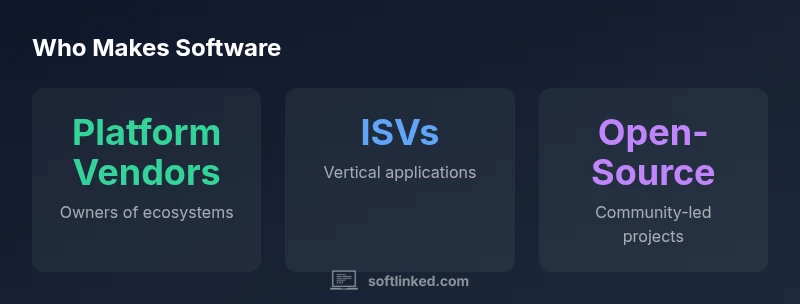
Think of software makers as a layered ecosystem. Platform vendors provide the base environments and runtimes that others build upon (for example, hosting, databases, AI services, and developer tools). Independent software vendors (ISVs) craft specialized applications for verticals such as finance, healthcare, or education. Startups and startup studios often experiment with new ideas and novel business models, accelerating disruption. Open-source communities contribute reusable building blocks, standards, and governance practices that lower barriers to entry and accelerate innovation. The interaction among these players drives interoperability and compound value for end users. The result is not a single monolith but a distributed network of contributors who collectively shape the software you use. For learners and practitioners, recognizing these roles helps in choosing tools, partnerships, and development approaches that align with goals, timelines, and risk tolerance.
How open-source contributes to software makers
Open-source software changes how products are created and maintained. It lowers costs, accelerates experimentation, and invites broad peer review that improves security and reliability. However, open-source isn’t free of governance challenges: licensing choices, contributor management, and risk of fragmentation require disciplined policies. Many organizations combine open-source components with proprietary code, paying for enterprise-grade support or dedicated maintainers. The result is a hybrid model where community-driven projects become the core of platforms, tools, and services, while vendors provide value through integration, training, and productization. Students and developers benefit from hands-on exposure to real-world software ecosystems, learning how to evaluate licenses, read contributor guidelines, and participate responsibly. Understanding open-source dynamics also helps in assessing the reliability of a software maker’s dependency stack and the long-term viability of critical components.
Build vs buy vs customize: decision framework
Choosing whether to build in-house, buy from a vendor, or customize an existing solution is a core decision. A build-first approach gives maximum control but requires time, talent, and risk management. A buy-or-venture model accelerates delivery, spreads risk, and taps external expertise but may constrain customization and IP retention. Customization sits between, enabling tailored features while leveraging existing foundations. The decision should factor in strategic alignment, required capabilities, regulatory obligations, and total cost of ownership over the product lifecycle. A practical framework includes: 1) describe the required outcomes; 2) map the risks and constraints; 3) evaluate the ecosystem for integration and support; 4) pilot in a sandbox; 5) plan an exit strategy if needed. If an organization uses multiple models, ensure architectural seams are clean, such as well-defined interfaces, versioning, and governance policies to prevent lock-in.
Evaluation criteria for software makers
To evaluate software makers, start with capability and track record. Look for verification through case studies, reference customers, or independent audits. Consider the maturity of the development process, release cadence, security practices, and data governance. Assess the quality of documentation, developer experience, and community or partner ecosystems, including maintenance commitments and escalation paths. Reliability, scalability, and compatibility with existing tools matter as much as price and licensing. Finally, examine cultural fit: how transparent is communication, how well does the maker handle feedback, and how resilient is their roadmap to market shifts. A well-scored decision matrix that assigns weights to technical, business, and strategic criteria helps teams justify their choice and communicate decision rationale to stakeholders.
Case examples: fictional scenarios illustrating different maker models
Imagine a mid-sized enterprise deciding between three routes: 1) adopt an open-source core with vendor-provided support; 2) license proprietary software from a platform vendor and integrate with in-house systems; 3) engage a startup studio to co-develop a custom solution. Each path has trade-offs in cost, speed, control, and risk. By mapping requirements, risk tolerance, and the organization's ability to manage complex ecosystems, teams can choose the approach that best aligns with strategic goals. The key takeaway is that software creation is rarely a solo effort; it’s a collaborative process across the ecosystem, and strategy should reflect that reality.
Common software-maker models and their outputs
| Model Type | Definition | Deliverables or Outputs |
|---|---|---|
| Proprietary Software | Closed-source with vendor licensing | Executable software, installers, updates, and SLAs |
| Open Source Software | Public licenses with community governance | Source code, issue trackers, community docs |
| SaaS (Cloud Software) | Cloud-hosted service with subscriptions | Web app access, APIs, dashboards |
Your Questions Answered
Who typically makes software?
A mix of in-house teams, software vendors, startups, and open-source communities collaborate to create software. The exact mix depends on strategic goals, risk tolerance, and market needs.
Software is built by many players, not just one company.
What is the difference between proprietary software and open-source software?
Proprietary software is closed-source with licenses and vendor support. Open-source software makes source code available under licenses and invites community contributions.
Proprietary is closed; open-source is open for study and modification.
Why is SaaS so popular?
SaaS delivers cloud-hosted software on a subscription basis, reducing upfront costs and enabling automatic updates and scalable usage.
SaaS is popular because you pay for what you use and always get current features.
How should I evaluate a software maker?
Assess track record, security posture, customer references, ecosystem, support terms, and alignment with your goals.
Check their history, safety practices, and the strength of their partner network.
Are there still single-company software makers?
Yes, large platform vendors exist, but the software landscape is multi-player with many contributors and collaborators.
There are big players, but many others contribute across ecosystems.
What role does open-source play in software making?
Open-source accelerates innovation and lowers entry barriers, but requires governance and careful license management for reliability.
Open-source speeds up development when managed well.
“Software creation today is a distributed effort across vendors, startups, and communities—not a single factory. The most effective buyers navigate this ecosystem with clear architecture and governance.”
Top Takeaways
- Identify your goals before choosing a maker
- Expect a multi-part ecosystem, not a single company
- Evaluate security, governance, and data devenvironment impact
- Open source accelerates innovation when governance is strong
- Use a structured decision framework for build/buy/customize