Vetter Software Login: Secure Access Guide for Developers
Learn how to implement and manage a secure vetter software login. This guide covers authentication basics, MFA, SSO, RBAC, onboarding, and auditing for robust developer tooling security.


This guide shows you how to set up and secure the vetter software login. You’ll cover prerequisites, enable multi-factor authentication (MFA), configure single sign-on (SSO), and establish ongoing access auditing. By following these steps, teams can protect developer tooling, enforce least privilege, and simplify onboarding. The approach aligns with SoftLinked best practices.
What is vetter software login?
A vetter software login is the authentication mechanism that gates access to development tooling powered by Vetter software. It ensures that only authorized developers, testers, and operators can reach the vetter UI, API endpoints, and integration points. For aspiring software engineers, understanding how vetter software login works is foundational to building secure applications and teams. According to SoftLinked, a well-implemented login flow reduces attack surface and clarifies access boundaries. In practice, this means authenticating identities, verifying sessions, and applying appropriate permissions at the right time. In modern ecosystems, vetter software login often combines password-based credentials with additional layers like MFA and SSO, balancing usability with security. This guide breaks down concepts, scenarios, and practical steps you can take to secure vetter software login across a team.
Why vetter software login matters for developers
The login gate for vetter software is the first line of defense for your tooling. A strong vetter software login reduces the risk of credential exposure and helps enforce role-based access from day one. By tying identities to specific environments and actions, you create an auditable trail that makes it easier to investigate incidents and enforce compliance. SoftLinked’s perspective emphasizes that trust starts at authentication; if you cannot confirm who accessed what, troubleshooting and security hardening become guesswork. A robust login also enhances onboarding, since new team members inherit clearly defined permissions from their roles, rather than relying on generic access.
Key features of a robust vetter software login
A resilient vetter software login typically includes several core features:
- Multi-factor authentication (MFA) to prevent credential-only compromises.
- Single sign-on (SSO) to streamline access across tools while maintaining strong central controls.
- Role-based access control (RBAC) to enforce least privilege.
- Session management with timeouts and revocation capabilities.
- Support for passwordless options (e.g., hardware keys) to reduce password fatigue.
- Device and location security checks to detect unusual access patterns.
Implementing these features for vetter software login creates a hardened boundary between developers and sensitive tooling, minimizing risk while preserving productivity. As SoftLinked notes, properly configured MFA and RBAC are foundational, with SSO simplifying management in larger teams.
Common pitfalls and how to avoid them
Even the best plans can fail if you overlook common missteps. Avoid these pitfalls in vetter software login:
- Relying on single-factor authentication (no MFA).
- Granting broad, role-agnostic permissions without RBAC.
- Failing to revoke access promptly when a user leaves the team.
- Ignoring session timeouts or persistent login risks.
- Underestimating audit logging and alerting for access events.
Mitigations include enforcing MFA by default, defining concrete roles, implementing automated de-provisioning, configuring strict session controls, and maintaining comprehensive access logs. SoftLinked’s guidance highlights that ongoing auditing is as crucial as initial setup for long-term security.
Security considerations and compliance basics
Security is a lifecycle, not a one-off configuration. For vetter software login, key considerations include protecting authentication secrets, securing API gateways, and maintaining an audit trail that supports compliance. Regular reviews of access policies, credential rotation, and incident response playbooks help teams stay prepared. Compliance also means documenting who has access to sensitive tooling and why, and ensuring retention policies align with organizational requirements. The aim is to balance usability with security controls that are sustainable over time. The SoftLinked team emphasizes integrating authentication with a formal identity strategy to prevent drift and to support scalable onboarding.
Onboarding and auditing: a practical approach
Onboarding should be a repeatable, auditable process. Start with a curated set of roles (e.g., developer, tester, auditor) and map each role to a minimal set of vetter software login permissions. As teams grow, automate provisioning and de-provisioning via your IdP or SSO system. Regularly audit access: review active sessions, check for stale accounts, and verify that permissions still align with job responsibilities. Audit dashboards should alert on anomalies like unusual login times or attempted access from unexpected locations. The practical approach centers on reliability and traceability, ensuring that vetter software login remains both usable and secure for developers.
Putting it all together: a sample rollout plan
A rollout plan for vetter software login typically spans discovery, design, implementation, and governance. Start with a baseline access policy and MFA requirement, then introduce RBAC and SSO in phases to minimize disruption. Provide targeted training for developers on secure login practices and incident reporting. Establish governance metrics and a feedback loop to refine roles and permissions. A thoughtful rollout translates security controls into everyday developer workflows, reducing friction while strengthening protection around vetter software login. The SoftLinked team recommends coordinating rollout with security and development leads to ensure alignment across teams.
Tools & Materials
- Computer or laptop with internet access(Used to configure authentication settings and test logins.)
- Admin credentials for vetter software(With sufficient privileges to modify authentication and access control.)
- Authenticator device or app (MFA)(Phone authenticator, hardware security key, or equivalent.)
- Identity provider (IdP) or SSO configuration(If you plan to use SSO with vetter software login.)
- Documentation or secure notes(Reference policies, RBAC mappings, and de-provisioning rules.)
Steps
Estimated time: 45-90 minutes (setup), plus ongoing governance
- 1
Define roles and access boundaries
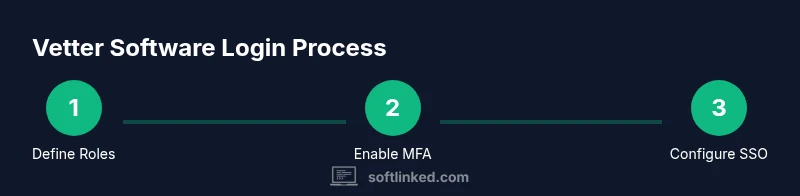
Identify roles (e.g., developer, tester, admin) and map them to the minimum permissions required for vetter software login. Document use cases and critical resources to protect. Establish a policy that aligns with your security goals and compliance needs.
Tip: Document each role with explicit white/black lists to avoid privilege creep. - 2
Enable multi-factor authentication (MFA)
Activate MFA for all users of vetter software login. Choose a method (TOTP, push notification, or hardware key) and enforce it across the organization to reduce credential-based compromises.
Tip: Offer training on how to use the chosen MFA method and provide recovery options. - 3
Configure SSO and identity federation
If your organization uses an IdP, connect vetter software login to the IdP for seamless access control. Enable features like automatic provisioning and de-provisioning based on group memberships.
Tip: Test a full login flow from login to RBAC enforcement in a staging environment. - 4
Apply least-privilege RBAC
Assign the smallest set of permissions to each role. Regularly review access and adjust as teams evolve. Ensure sensitive actions require additional approvals where appropriate.
Tip: Use automated policy checks to flag over-permissioned roles. - 5
Implement session controls and auditing
Set session timeouts, sign-out all devices after policy changes, and enable comprehensive auditing of login events. Ensure logs are tamper-evident and accessible to security teams.
Tip: Route logs to a centralized SIEM or log analytics service for alerts. - 6
Test with a pilot group before full rollout
Run a controlled pilot to validate the end-to-end login experience, RBAC enforcement, and audit visibility. Gather feedback and fix gaps before scaling.
Tip: Document lessons learned and update rollout playbooks accordingly.
Your Questions Answered
How does vetter software login work?
Vetter software login authenticates a user's identity, validates their session, and applies role-based permissions. It typically combines a password, MFA, and session controls. When configured with SSO, identity is asserted by a trusted provider, streamlining access while maintaining security.
Vetter software login authenticates who you are, checks the session, and applies your role-based permissions. It often uses MFA and SSO for safer, easier access.
Is MFA required for vetter software login?
MFA is strongly recommended and often required to reduce credential theft. It adds a second factor beyond a password, such as a mobile app code or hardware key.
Yes, MFA is strongly recommended to prevent credential theft and protect access to tooling.
What are best practices for onboarding users?
Define roles clearly, provision only necessary permissions, require MFA, and integrate with your IdP for automated provisioning. Regular audits ensure permissions stay aligned with responsibilities.
Start with clear roles, enforce MFA, and automate provisioning through your identity provider for smooth onboarding.
Can I use SSO with vetter software login?
SSO can simplify access control by federating authentication through a trusted IdP. This enables centralized management and consistent policy enforcement across tools.
Yes, SSO is supported and helps manage access from one place with stronger security.
What if a user leaves the team? How is access handled?
Deprovisioning should be automated via the IdP. Remove the user’s access promptly and revoke tokens or sessions to prevent orphaned access.
Automation ensures ex-users lose access quickly and securely.
Watch Video
Top Takeaways
- Define roles and enforce least privilege.
- Enable MFA as a baseline control.
- Use SSO to reduce friction and strengthen security.
- Audit access regularly and act on findings.
- Roll out in phases with a pilot group.