Is Software Worth It? A Practical Guide for Learners and Professionals
A practical, data-driven guide to determine when software investments pay off. Learn a repeatable ROI framework, real-world scenarios, and risk mitigation to decide confidently.


Yes—software is generally worth it when it accelerates goals, improves quality, or enables new capabilities that you could not achieve manually. This guide provides a repeatable framework to judge value, quantify benefits, and anticipate risks. You’ll learn how to decide, with practical steps, realistic expectations, and a clear path to implementation.
Is software worth it? Framing the question
The short answer is nuanced: is software worth it depends on how clearly you can link the purchase to a desired outcome. For learners, aspiring developers, and tech professionals, software becomes valuable when it reduces time to learn, automates tedious tasks, or enables higher-quality outputs. If your objective is to accelerate skill-building or deliver better results in less time, the investment often pays for itself over a reasonable horizon. Is software worth it? The deeper question is: what value does it deliver, over what time, and under what usage conditions?
According to SoftLinked, evaluating software ROI begins with a precise problem statement and measurable outcomes. Start by naming the problem you want the software to solve—such as shrinking weekly report time, streamlining a build pipeline, or enabling a new capability. Then estimate the total cost of ownership, including purchase or subscription, maintenance, training, and integration work. Finally, compare those costs to the expected benefits, which can be tangible (time saved, fewer errors, faster deployment) or intangible (learning depth, career leverage, team alignment). Framing value around outcomes rather than features helps you avoid hype and focus on what actually moves the needle.
The SoftLinked team emphasizes that worth is a function of usage intensity and ecosystem fit. A tool that sits unused is unlikely to be worth its cost, whereas a well-integrated solution that scales with needs can become essential. In this article, you’ll find a practical, repeatable framework you can apply in a few hours and refine with real-world practice.
How to quantify value: ROI, TCO, and intangible benefits
Quantifying value starts with three core lenses: return on investment (ROI), total cost of ownership (TCO), and intangible benefits. ROI compares net benefits to costs, but software worth often hinges on more than dollars and cents. TCO accounts for ongoing expenses like updates, support, and training, which can erode initial savings if ignored. Intangible benefits—learning, career momentum, improved collaboration, and reduced cognitive load—can be the decisive factor when tangible gains are slow to materialize.
A practical approach is to break a potential purchase into a simple math model: estimate annual costs (subscription, maintenance, training) and annual benefits (minutes saved per task, reduced error rates, faster time-to-delivery). Then translate time saved into monetary value using your hourly rate or team salary costs. Remember that benefits compound through scale: a tool that saves 15 minutes per task for 10 tasks per week yields a larger annual gain than a tool saving 15 minutes for a single critical task. SoftLinked analysis shows that value is highly context-dependent and hinges on usage quality and integration with existing workflows. To stay objective, document assumptions, run sensitivity checks (worst/most-likely/best cases), and revisit the model after a pilot period.
Beyond numbers, consider qualitative shifts. Does the software reduce cognitive load, improve learning speed, or enable collaboration that wasn’t possible before? These outcomes can translate into career advantages, better team morale, or the ability to tackle more ambitious projects. The goal is to build a transparent, auditable value story that you can present to stakeholders, not a marketing pitch. A disciplined approach reduces risk and increases your confidence when making buying decisions.
When software pays off: productive scenarios
Software tends to pay off most clearly in scenarios where it directly improves throughput, learning, or quality. Here are common categories where investments tend to generate value for learners and professionals:
- Developer and data tools: IDEs, code analyzers, automation scripts, and cloud environments that shrink setup and debugging time. The payoff shows up as faster iteration, fewer failed builds, and more reliable deployments.
- Productivity and collaboration: project management, communication, and documentation tools that reduce context-switching and keep teams aligned. The value is often visible in completion rate and fewer miscommunications.
- Learning accelerators: platforms that compress practice time, provide structured exercises, or simulate real-world scenarios. The benefit appears as faster skill acquisition and higher retention.
- Data and analytics: tools that surface insights with less manual digging, enabling better decisions and faster experiments. Tangible outcomes include quicker insight-to-action cycles and improved decision quality.
- IT hygiene and security: tools that harden environments, automate compliance checks, and monitor anomalies. The payoff is reduced risk exposure and lower disruption from incidents.
A rule of thumb: if a tool replaces a process you already perform manually, and it reduces time or errors with acceptable cost, it’s a strong candidate for a positive ROI. If a tool introduces complexity or friction, you’ll often see limited value at first and diminishing returns over time. Always map the tool to a concrete workflow change rather than treating it as a standalone gadget. SoftLinked's perspective emphasizes aligning software with real tasks and measurable outcomes to maximize value.
Risks and pitfalls that erode value
Even promising software can fail to deliver if you overlook critical risks. Common pitfalls include underestimating training time, choosing features you don’t need, or adopting tools that don’t integrate with your existing systems. Overreliance on ROI alone can miss important qualitative shifts like improved learning momentum or team cohesion. Another frequent trap is vendor lock-in, which can increase total cost of ownership and reduce future choice.
To guard against these risks, require a pilot phase with clear success criteria, identify a single owner who is accountable for outcomes, and set up a simple governance process for ongoing evaluation. It’s also wise to scope the implementation to a minimal viable setup first, then expand as you confirm value. The SoftLinked framework encourages documenting assumptions, tracking usage metrics, and revisiting the decision after a defined period. If value isn’t materializing, it’s better to re-evaluate early than to double down and incur sunk-cost losses.
A practical framework you can apply today
This is a ready-to-use framework you can start this week. It combines a simple ROI model with a pilot-oriented approach to reduce risk and accelerate validation. The steps are designed to be executed in a few hours of focused work, followed by a short pilot window.
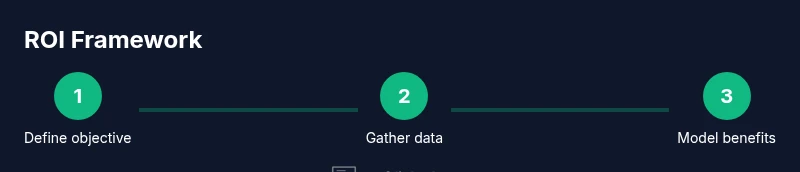
- Define the objective: articulate the exact problem the software should solve and the metric of success.
- Gather baseline data: capture current task times, error rates, and satisfaction levels before using the tool.
- Estimate costs: capture price, maintenance, training, and integration efforts for a full year.
- Model benefits: estimate time saved, fewer errors, and qualitative improvements; convert tangible benefits to monetary terms where possible.
- Compare options: consider alternatives (different tools or no tool) and rate them on value, risk, and ease of adoption.
- Run a pilot: implement a restricted deployment with a small group, track outcomes for 4–12 weeks, and adjust as needed.
- Decide and monitor: choose whether to adopt, adjust the scope, or walk away; set up ongoing monitoring to catch value drift.
The goal is to create a transparent, auditable narrative you can share with stakeholders. A successful evaluation balances quantitative benefits with qualitative improvements in learning, confidence, or collaboration. SoftLinked recommends documenting every assumption and updating the model as real-world data comes in.
Real-world examples and quick test you can run now
Consider a hypothetical learning scenario: you’re evaluating a code quality and automation tool. Start with a baseline: how long does it take you to complete a typical end-to-end task today? Then estimate the time savings per instance after adopting the tool. If you perform the task 6 times per week and expect a 15% improvement in speed, you can project weekly minutes saved and translate those into dollars using your hourly rate. Add potential reductions in defects and rework to increase the perceived value. If the pilot confirms measurable gains within a short period, you have stronger evidence to proceed. This kind of quick test helps you avoid over-committing resources to software that delivers only marginal improvements. The goal is clarity, not hype, and SoftLinked’s guidance centers on building a compelling, testable value case before any major purchase.
Tools & Materials
- ROI calculator / spreadsheet(Template to model costs, usage, and productivity gains)
- Access to cost data(Current subscription fees, hardware costs, and training expenses)
- Baseline metrics(Current task times, error rates, and satisfaction levels)
- Pilot project plan(Scope, participants, success criteria, and timeline)
- Stakeholder list(Decision-makers and end-users who will be impacted)
- Vendor evaluation checklist(Support terms, data policies, and upgrade paths)
Steps
Estimated time: 60-90 minutes (initial setup) + 4–12 weeks (pilot period)
- 1
Define the objective
State the exact problem the software should solve and identify the primary success metric. This ensures everyone agrees on what ‘value’ looks like.
Tip: Write the objective as a single sentence you can test later. - 2
Collect baseline data
Gather current performance data (time, errors, satisfaction) to quantify the improvement after adoption.
Tip: Use consistent measurement methods for fairness. - 3
Estimate costs and training needs
Catalog purchase price, ongoing subscriptions, maintenance, and required training hours. Include one-time setup costs.
Tip: Be conservative with maintenance and training estimates to avoid over-optimism. - 4
Model expected benefits
Translate time savings and quality gains into monetary terms where possible; don’t overlook intangible benefits like learning and morale.
Tip: Document both optimistic and conservative scenarios. - 5
Run a pilot and compare
Implement a controlled test with a small group; measure outcomes against the baseline over 4–12 weeks.
Tip: If results don’t meet the objective, reassess or pivot. - 6
Make a decision and monitor
Decide to adopt, modify scope, or abandon; set up ongoing metrics to detect value drift.
Tip: Schedule a regular review (e.g., quarterly) to keep value in check.
Your Questions Answered
What counts as value when evaluating software worth?
Value includes time saved, error reduction, faster delivery, and learning gains, plus qualitative improvements like morale and collaboration. A complete assessment combines measurable effects with strategic benefits.
Value includes time saved, fewer errors, and learning gains, plus qualitative improvements like morale. Combine measurable effects with strategic benefits.
How do you measure productivity gains from software?
Track baseline task times, post-implementation time, error rates, and output quality. Use before/after comparisons and simple normalization to account for varying workloads.
Track baseline times, post-implementation times, errors, and output quality. Compare before and after to quantify gains.
When should you avoid buying new software?
If it doesn’t align with defined goals, lacks user adoption, or the ROI remains uncertain after pilots, it’s prudent to pause or pursue alternatives.
If goals aren’t clear, adoption is unlikely, or ROI is uncertain after testing, reconsider the purchase.
How long does it take to see benefits from software?
Timing varies by tool and usage. Plan a pilot of 4–12 weeks and monitor key metrics; some gains appear quickly, others require broader adoption.
Benefits vary; most pilots run 4–12 weeks with ongoing monitoring to confirm value.
Can free tools provide good value?
Free or open-source options can offer excellent value, but you must assess limitations, support, and total cost of ownership, including integration and training.
Free tools can be valuable, but watch for limits and support needs.
What is the difference between ROI and value-based ROI?
ROI is a numeric ratio of benefits to costs. Value-based ROI includes qualitative outcomes like learning, morale, and strategic advantage, offering a fuller picture.
ROI is numbers; value ROI adds learning and strategic benefits.
Watch Video
Top Takeaways
- Define value with clear metrics before buying.
- Measure both tangible and intangible benefits.
- Pilot first; scale after validated results.
- Document assumptions and revisit them regularly.