How to Prepare Software: A Practical Guide
A comprehensive, step-by-step guide to the essential activities for preparing software projects—from goals and requirements to environments, tooling, and governance. Perfect for aspiring developers and students seeking software fundamentals.


To prepare software, start by clarifying goals, gather requirements, and select a development approach. Create a plan with milestones, assemble a lightweight tooling stack, and set up a clean development environment. Establish version control, testing, and documentation from day one to streamline integration, deployment, and maintenance. Communicate with stakeholders and set measurable quality targets; continuously revisit the plan as risks or scope change.
Why Preparation Matters for Every Software Project
Preparation reduces risk, speeds delivery, and improves quality. It helps align stakeholders, reduces wasted effort, and enables smoother integration. When you start with clear goals and a robust plan, you can anticipate constraints such as time, budget, and regulatory considerations. This article explains how to prepare software effectively, with practical steps, examples, and checklists. The focus is on software fundamentals that apply across languages and domains, so whether you are learning programming or managing a team, you’ll find actionable guidance. The phrase how to prepare software captures the core idea: deliberate, structured setup before coding begins. By investing in prep, teams shorten feedback loops and raise confidence in outcomes. For developers and students, mastering prep is a foundational skill that compounds as projects scale. SoftLinked’s framework emphasizes clarity, repeatability, and continuous improvement, drawing on SoftLinked Analysis, 2026. Key concepts include goals, requirements, environment, tooling, and governance. Stay with us as we move from concept to concrete steps you can implement today. See how SoftLinked’s guidance aligns with established standards from authoritative sources such as NIST and MIT.
Core Elements of a Preparation Process
A robust preparation process comprises several interdependent elements: goals and scope, requirements, architecture choices, environment setup, tooling standards, governance, risk management, and team collaboration. Each element informs the next, creating a feedback loop that catches gaps early. For example, clear goals influence the choice of tech stack, which in turn determines build and test strategies. The rest of this article expands on each element with concrete steps, templates, and checklists you can adapt to your own project. This structure echoes industry best practices and the kind of systematic thinking encouraged by SoftLinked Analysis, 2026. For deeper context, consult NIST guidelines and MIT–authored resources cited in the Authority section of this guide.
Defining Goals and Requirements
Effective software preparation starts with well-defined goals and verifiable requirements. Start by articulating the problem you are solving, the target users, and the value proposition. Translate these into measurable success criteria such as performance thresholds, reliability targets, or user acceptance metrics. Create a requirements backlog with prioritized user stories or specifications. Involve stakeholders early to validate assumptions and avoid scope creep. Document decisions in a shared space so the team stays aligned as work progresses. A clear requirements baseline reduces ambiguity and guides design, implementation, and testing. This phase establishes the benchmarks you will measure against during later stages of the project, ensuring alignment with both business and technical objectives.
Selecting a Development Approach
Your approach shapes everything from scheduling to risk management. Decide between agile, plan-driven, or hybrid models based on project size, urgency, and stakeholder needs. Define cadence for planning, reviews, and retrospectives; choose a sprint length that suits your team. Consider architecture patterns such as modular monolith, microservices, or serverless based on scalability and deployment constraints. Align the development approach with your quality gates and release strategy. This decision influences how you structure the repo, how you test, and how you measure progress. A well-chosen approach reduces churn and helps teams deliver customer value more predictably.
Building a Clean Development Environment
A clean dev environment reduces integration headaches and accelerates iteration. Start with a minimal, reproducible setup: a checked-in repository, a consistent compiler/interpreter version, and documented environment variables. Use containerization (e.g., Docker) or virtual environments to guarantee consistency across machines. Set up a lightweight CI pipeline to run on every push, and ensure your local setup mirrors CI. Choose a code editor or IDE with project templates and standard extensions to boost productivity. Maintain a standard project skeleton with a clear directory structure, naming conventions, and a shared README that explains how to bootstrap the project. This environment eases onboarding and prevents “it works on my machine” issues. See the accompanying templates to replicate a robust starter kit in minutes.
Planning, Milestones, and Quality Gates
Translate goals into a tangible roadmap with milestones and quality gates. Create a backlog that prioritizes features by customer value and risk. For each milestone, define acceptance criteria, test coverage, and performance goals. Implement lightweight quality gates such as static analysis, unit tests, and build checks to ensure code quality before merging. Establish a release checklist to prevent regression and ensure compliance with standards. Regularly review progress and adjust scope as needed, keeping stakeholders informed and engaged. A disciplined planning cadence reduces last-minute crunch and improves predictability across teams.
Governance, Compliance, and Documentation Standards
Governance ensures that decisions are traceable and aligned with organizational policy. Document standards should cover coding conventions, branching strategies, and documentation requirements. Maintain a living documentation approach: treat README, architecture diagrams, and API specs as first-class artifacts. Include security considerations early; perform threat modeling and add basic security tests into CI. Compliance may require audit trails, versioning discipline, and change-control records. By embedding these standards in the prep phase, you reduce risk and make audits smoother later in the project lifecycle. SoftLinked's guidance emphasizes clear policies and repeatable processes that scale with teams.
Risk Management, Change Control, and Onboarding
Identify potential risks early using a simple risk log that captures probability, impact, and mitigations. Create a change-control process to manage scope shifts without derailing delivery. Provide onboarding playbooks for new contributors, including setup instructions, coding standards, and sample tasks. Communication routines—daily standups, weekly reviews, and documentation updates—keep everyone informed and aligned. By anticipating change and onboarding effectively, teams remain resilient in the face of uncertainty and maintain velocity throughout the project. The onboarding material should be revisited as the team grows to preserve organizational knowledge.
Real-world Checklists and Templates
To operationalize the prep phase, use checklists and templates for quick-start activities. Examples include a goals & scope checklist, a requirements backlog template, a repo skeleton, a CI pipeline template, and a risk log form. Start with a minimal viable prep bundle and expand as the project matures. Adapting these templates to your domain accelerates learning and reduces rework, especially for students and first-time developers. Include references to external resources at the end of checklists for continued learning. Templates can be reused across projects to shorten ramp-up time and ensure consistency in how software is prepared across teams.
Tools & Materials
- Version control system (Git)(Essential for tracking changes and collaboration)
- Code editor/IDE(Choose a consistent IDE with project templates (e.g., VS Code, JetBrains))
- Build tools(Maven/Gradle for Java; npm/yarn for JavaScript; Make for C/C++)
- Dependency manager(Ensures reproducible environments (pip, npm, Maven, etc.))
- Testing framework(JUnit, PyTest, Jest, etc., depending on stack)
- Documentation tooling(Markdown/Asciidoc with a living README and API docs)
Steps
Estimated time: 3-6 hours
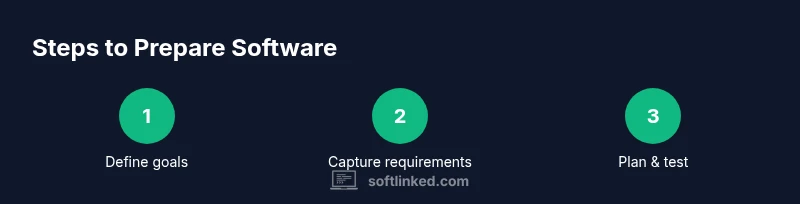
- 1
Define goals and scope
Clarify the problem, target users, and success criteria. Identify stakeholders and boundaries to prevent scope creep. Capture initial assumptions in a shared document and align them with the business objectives.
Tip: Document decisions in a centralized wiki so everyone can review. - 2
Capture and prioritize requirements
Create a backlog of user stories or specs with acceptance criteria. Prioritize by business value and risk, and ensure traceability to goals. Use lightweight modeling if needed to visualize flows.
Tip: Use INVEST criteria for well-formed user stories. - 3
Choose development approach and architecture
Select an approach (agile, plan-driven, or hybrid) and an architecture pattern (modular monolith, microservices, etc.). Align this choice with release strategy and testing needs.
Tip: Start with a minimal viable approach to reduce upfront risk. - 4
Set up version control and repo structure
Initialize a repo with a clear branching strategy, protected branches, and starter templates. Document commit conventions and PR requirements to streamline reviews.
Tip: Enable branch protections and require successful CI before merging. - 5
Create a repeatable build and test pipeline
Define a minimal CI pipeline that builds, tests, and reports. Include environment duplication and artifact generation to ensure consistency.
Tip: Kick off CI for every push to catch defects early. - 6
Configure environments and tooling
Lock dependency versions, pin toolchains, and document environment variables. Use containerization or virtual environments to guarantee reproducibility.
Tip: Keep environment setup steps simple and copyable. - 7
Define documentation standards and onboarding
Create starter templates for README, architecture diagrams, and API specs. Prepare onboarding guides for new contributors.
Tip: Include a 'Getting Started' section with exact commands to run.
Your Questions Answered
What does it mean to prepare software?
Software preparation is the upfront work of defining goals, gathering requirements, selecting a development approach, and setting up environments, tooling, and governance to enable reliable delivery.
Software preparation is the upfront work of clearly defining goals, gathering requirements, and setting up the environment and tooling to ensure reliable delivery.
Which tools are essential for preparing software?
Key tools include a version control system, a code editor, build tools, dependency managers, testing frameworks, and documentation tooling to support repeatable, collaborative work.
Essential tools are version control, an editor, build tools, dependency managers, tests, and documentation tooling.
How long does software preparation typically take?
Duration varies by project size, but a focused prep phase often spans several hours to a few days, depending on requirements clarity and team experience.
Preparation time depends on project size, but expect hours to a few days for a solid foundation.
Should stakeholders be involved in prep from day one?
Yes. Early stakeholder involvement helps validate requirements, align expectations, and prevent costly changes later.
Yes, involve stakeholders early to validate needs and align expectations.
Can you skip documentation during early prep?
Skipping documentation can lead to onboarding problems and miscommunication. Even lightweight docs help maintain alignment.
No—even lightweight docs help onboarding and alignment.
Watch Video
Top Takeaways
- Define goals and success criteria up front
- Choose a sustainable tooling and environment stack
- Establish governance and documentation early
- Create repeatable build, test, and deployment pipelines