How Do Software Engineers Make Software? A Practical Guide
A comprehensive, step-by-step guide explaining how software engineers translate ideas into reliable software, covering lifecycle, tooling, testing, design, learning paths, and career development.


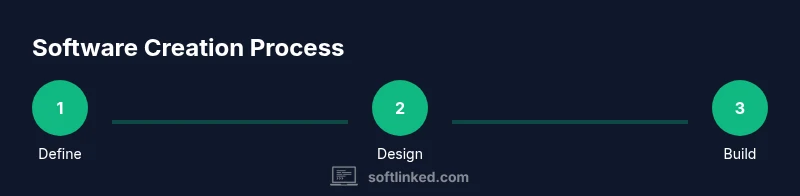
How do software engineers make software? They follow a structured lifecycle: define the problem, gather requirements, design an architecture, implement with code, run tests, and deploy to production, then monitor and maintain. They collaborate with product, design, and operations teams, choose the right tools, and iterate based on feedback. In short, software engineers translate ideas into reliable, scalable software systems.
What 'how do software engineers make' means in practice
In practice, the phrase describes the journey from an idea to a working product. It isn’t just typing code; it’s solving real problems with thoughtful design, testing, and collaboration. According to SoftLinked, aspiring developers benefit from mapping urban-like workflows: understand the goal, translate it into concrete features, and iterate based on user feedback. This mindset helps you connect theory with real-world outcomes and prepares you for team-based development.
The software engineering lifecycle
Software engineers typically operate within a lifecycle that turns ambiguous ideas into functioning software. The cycle begins with understanding user needs and articulating clear acceptance criteria. Teams then move to design, where they select an architecture (monolith, microservices, or a hybrid) and define interfaces between components. Implementation follows, with developers translating designs into code in chosen languages. After coding, tests are written and executed to catch defects early. Finally, the software is prepared for production with deployment scripts, monitoring, and rollback plans. This lifecycle is rarely linear; feedback from testing, users, and runtime data loops back into earlier steps, prompting refinements. Agile methods—short iterations, frequent reviews, and continuous integration—are widely used to keep work predictable and adaptable. While the specifics vary by team and project, the core idea stays the same: deliver value incrementally, validate assumptions, and evolve the product based on real-world usage. Effective teams document decisions, maintain traceability, and ensure that every release is reproducible. The result is software that not only works but also meets reliability, performance, and security expectations.
Roles and collaboration
Software engineering is a team sport. A typical cross-functional squad includes a product manager who defines goals, a UX designer who shapes user interactions, several software engineers who implement features, a QA engineer who guards quality, and a DevOps specialist who manages deployment and reliability. The tech lead or architect guides technical direction, ensuring consistency across modules. Communication happens through lightweight rituals—daily standups, planning meetings, and demos—and through shared artifacts like user stories, design diagrams, and CI pipelines. Clear ownership and transparent decision-making reduce confusion and accelerate delivery. In practice, engineers learn to explain trade-offs between speed and quality, choose appropriate abstractions, and balance long-term maintainability with short-term milestones.
Tools, architectures, and workflows
Modern software teams rely on a diverse toolset. Common languages include Python, JavaScript/TypeScript, Java, and Go, chosen for performance, ecosystem, and team expertise. Frameworks and libraries speed development, while version control (Git) underpins collaboration. Teams typically adopt CI/CD pipelines (GitHub Actions, GitLab CI, or Jenkins) to automate builds, tests, and deployments. Containerization (Docker) and orchestration (Kubernetes) support consistent environments and scalable deployments. Cloud platforms (AWS, Azure, or GCP) host services, databases (PostgreSQL, MongoDB, or Redis) store data, and monitoring tools (Prometheus, Grafana) reveal runtime health. Architectural decisions—monoliths versus microservices, event-driven vs request-driven design—shape how components communicate and scale. Documentation and dashboards become lifelines for onboarding new teammates and verifying system behavior over time.
Quality, testing, and maintenance
Quality hinges on a layered testing strategy. Unit tests validate individual functions, integration tests check interactions between modules, and end-to-end tests confirm user workflows. A strong test pyramid emphasizes many fast, isolated tests and fewer slow, end-to-end ones. Code reviews, linters, and static analysis catch issues early and raise standards. Performance profiling and load testing reveal bottlenecks under stress, guiding optimizations. Maintenance means refactoring when code smells appear, updating dependencies, and verifying backward compatibility with every change. Reliability is reinforced by robust logging, tracing, and alerting so incidents can be detected and resolved quickly.
Design principles and patterns
Sound design rests on principles like SOLID, DRY, KISS, and separation of concerns. Engineers favor loose coupling and high cohesion to keep systems modular and testable. Common design patterns—MVC, MVVM, repository, and factory—solve recurring problems and improve scalability. When architects decide between patterns, they consider maintainability, testability, and how components will evolve. Decisions about data models, caching strategies, and API contracts are codified to prevent drift. As systems grow, architectural reviews help balance agility with stability, and governance ensures that new features align with overall business goals.
Learning paths and career progression
Aspiring software engineers typically start by mastering fundamentals: programming basics, data structures, and algorithms. From there, they build small projects, contribute to open source, and learn version control and testing fundamentals. A structured learning path might progress from building simple console apps to full-stack web projects, then to more advanced topics like distributed systems or cloud computing. Continuous learning—reading code, practicing debugging, and building real projects—accelerates growth. Career trajectories branch into frontend, backend, mobile, data engineering, or devops, with senior roles focusing on architecture, mentorship, and strategic decisions. Formal education helps, but hands-on practice and consistent curiosity are the true accelerants.
Practical example: from idea to feature
Consider adding a feature: a user-authenticated to-do list. First, you translate the idea into requirements: users must sign in, securely store tasks, and support basic CRUD operations. Next, design an architecture with a small backend service, a REST API, and a simple frontend. Implement the backend in a chosen language, write unit and integration tests, and set up a CI pipeline to run tests on every push. Deploy to a staging environment, run manual and automated checks, then monitor error rates and user feedback. Finally, iterate by refining UI, improving performance, and adding accessibility checks. This concrete flow—from idea to production—illustrates how an engineer makes software that actually solves a problem.
Common pitfalls and optimization strategies
Common pitfalls include scope creep, insufficient early testing, and over-engineering. To avoid these, start with a minimal viable feature, establish clear acceptance criteria, and measure success with concrete metrics. Optimize by profiling early, prioritizing high-impact improvements, and avoiding premature optimization. Document decisions to prevent knowledge loss, keep dependencies up to date, and implement robust monitoring to detect regressions quickly. Finally, foster a culture of feedback: code reviews, post-mortems, and regular retrospectives help teams learn and improve.
Tools & Materials
- A computer with a modern IDE(Examples: VS Code, IntelliJ, PyCharm)
- Git and a remote repository(GitHub, GitLab, or Bitbucket access)
- CI/CD and testing infrastructure access(GitHub Actions, GitLab CI, or equivalent)
- Design and product documentation(Access to specs, user stories, and design guides)
- Local runtime environments(Docker or similar containers; local databases)
- Communication tools(Slack, Teams, or similar)
Steps
Estimated time: 4-6 weeks
- 1
Define objective and gather requirements
Clarify the problem, identify stakeholders, and capture acceptance criteria. Write user stories and measurable goals to guide the rest of the process.
Tip: Ask 'why' five times to uncover underlying needs. - 2
Design high-level architecture
Choose a structure (monolith vs microservices) and define interfaces between components. Create a rough data model and API contracts.
Tip: Prioritize modularity to ease testing and future changes. - 3
Set up repository and CI
Create a Git repo, establish branching strategies, and configure automated builds and tests to run on every commit.
Tip: Include a README and contribution guidelines from day one. - 4
Implement core features
Translate design into code with clear, small commits. Focus on delivering a working subset before polishing.
Tip: Write code that is easy to refactor later; avoid large, risky rewrites. - 5
Write tests and ensure quality
Create unit, integration, and end-to-end tests. Use linting and static analysis to catch issues early.
Tip: Automate as much testing as possible to reduce manual toil. - 6
Deploy to staging and verify
Push to a staging environment, run automated checks, and solicit QA feedback before production.
Tip: Include rollback plans and feature flags for safety. - 7
Monitor, learn, and iterate
Track performance, errors, and user feedback; plan refinements in the next sprint.
Tip: Set up dashboards that highlight actionable signals. - 8
Document and share lessons
Update docs, write post-mortems for incidents, and mentor teammates to spread knowledge.
Tip: Make documentation a part of the definition of done.
Your Questions Answered
What do software engineers actually do on a daily basis?
Software engineers design, implement, test, and maintain software systems. They collaborate with product teams, review code, and improve software quality through automation and monitoring. Daily activities vary by role and project, but the core goal remains delivering reliable software.
Software engineers design, implement, test, and maintain software, working with product teams to deliver reliable systems. Day-to-day tasks vary, but the aim is high-quality software.
What is the difference between software engineering and programming?
Programming is primarily about writing code to perform tasks. Software engineering encompasses programming plus design, architecture, testing, documentation, and long-term maintenance. Engineers consider scalability, reliability, and user needs across the entire lifecycle.
Programming is coding; software engineering includes design, architecture, testing, and ongoing maintenance.
Which languages should a beginner learn first?
Beginners typically start with a language that balances readability and practicality, such as Python for beginners and JavaScript for web development. As you grow, add strongly-typed languages like TypeScript or Java to broaden your capability and understanding of complex systems.
Start with Python or JavaScript, then add TypeScript or Java as you gain experience.
How long does it take to learn software engineering fundamentals?
Fundamentals typically take several months of consistent practice, with longer trajectories for deeper specialization. A focused, project-based approach accelerates skill development more than studying concepts alone.
A few months to learn fundamentals with steady practice; longer for deeper specialization.
What career paths can software engineers pursue?
Software engineers can specialize in frontend, backend, full-stack, mobile, data engineering, DevOps, or software architecture. Senior roles often focus on design decisions, mentoring, and strategic improvements across systems.
Paths include frontend, backend, full-stack, mobile, data, DevOps, and architecture.
What about open-source contributions?
Contributing to open-source projects helps you practice real-world code, receive feedback from others, and demonstrate your impact to potential employers. Start with small issues, read contribution guidelines, and communicate clearly.
Open-source contributions are a great way to learn, get feedback, and show impact to employers.
Watch Video
Top Takeaways
- Define problems clearly before coding.
- Use a structured lifecycle to organize work.
- Test early and automate where possible.
- Collaborate across product, design, and operations.
- Continuously learn and document decisions.