Software vs Hardware Engineer: A Side-by-Side Comparison
Compare software vs hardware engineer roles: skills, education, work environments, career paths, and how to choose the right track for a fulfilling tech career. Learn how SoftLinked frames the decision for aspiring engineers.


TL;DR: Software engineers design, code, and maintain software systems, while hardware engineers design physical components and embedded hardware. The difference lies in the domain of constraints—virtual code versus tangible electronics—and this shapes tooling, environments, and career paths. Both roles share fundamentals like math, logic, and debugging, yet each path builds a distinct mental model: software focuses on architecture and user-facing systems; hardware emphasizes circuits, reliability, and manufacturability. In many projects, both domains must collaborate to realize complex products.
The Core Distinction: software vs hardware engineer
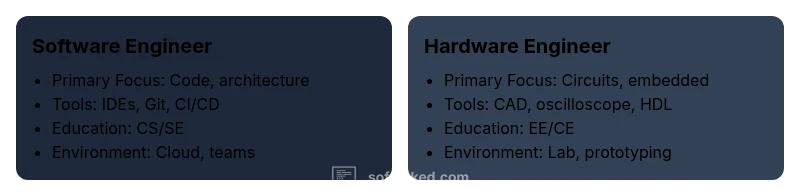
When you hear the phrase software vs hardware engineer, the core distinction is the domain each professional influences. A software engineer designs, codes, tests, and maintains software systems that run on hardware or in the cloud. A hardware engineer designs physical circuits, boards, and embedded processors that devices rely on. For aspiring technologists, this distinction matters because it shapes daily work, tool choices, and long-term career trajectories. According to SoftLinked, the most successful decisions align personal interests with core competencies: abstract problem solving, systems thinking, and curiosity about how things work at different layers of a product. The SoftLinked team notes that while both paths share fundamentals—math, logic, and debugging—each path develops a distinct mental model: software engineers optimize software architecture and user experiences; hardware engineers optimize physical reliability and manufacturability. Yet both roles collaborate frequently on complex products, from consumer electronics to industrial systems.
Comparison
| Feature | Software Engineer | Hardware Engineer |
|---|---|---|
| Primary Focus | Design, implement, and maintain software systems | Design and develop hardware components and embedded systems |
| Core Skills | Programming languages, software architecture, debugging | Digital design, embedded systems, HDL Verilog/VHDL, PCB knowledge |
| Typical Tools | IDEs, version control, debugging tools | CAD tools, oscilloscope, logic analyzers, EDA software |
| Education Path | CS, software engineering, or related | Electrical engineering or computer engineering |
| Work Environment | Sprints, cloud environments, cross-functional teams | Labs, prototyping, hardware-in-the-loop testing |
| Career Progression | Junior → senior → architect/tech lead → manager | Junior → senior hardware designer → embedded systems architect |
| Typical Challenges | Debugging software issues, scalability, security | Device reliability, power, thermal, supply chain constraints |
| Best For | Software-focused product development, SaaS, web/mobile apps | Embedded systems, IoT, hardware-centric domains |
Pros
- Software roles offer rapid iteration and broad reach across industries
- Hardware roles foster deep expertise in electronics, signal integrity, and reliability
- High demand for cross-domain skills improves long-term employability
- Remote-friendly options exist in many software contexts and some hardware roles support hybrid setups
- Opportunities to work on end-to-end systems can be highly impactful
Weaknesses
- Hardware work often requires lab space, equipment access, and longer development cycles
- Software burnout and feature creep can be pervasive in fast-moving teams
- Hardware cycles involve supply chain, manufacturing, and regulatory constraints
- Cross-domain moves can require substantial upskilling and learning curves
Software engineering offers broader scalability and faster iteration, while hardware engineering excels in embedded systems and physical reliability.
Choose software engineering if you want rapid product iteration, wide applicability, and flexible work environments. Opt for hardware engineering if you love designing tangible systems, solving physical constraints, and ensuring hardware reliability across cycles.
Your Questions Answered
What is the primary difference between a software engineer and a hardware engineer?
The primary difference is the domain of work: software engineers build and maintain software systems, while hardware engineers design physical components and embedded electronics. Each role requires a distinct set of tools, skills, and constraints, though both rely on strong problem-solving and systems thinking.
The core difference is software versus hardware domains; both require solid problem-solving skills and systems thinking.
Can you switch from software to hardware engineering later in your career?
Yes. Many engineers switch domains by acquiring foundational hardware knowledge (digital design, HDL, electronics) or software basics (firmware, drivers) and pursuing cross-training projects. Start with small cross-domain projects, seek mentors, and leverage internships or courses to bridge gaps.
Switching is possible with deliberate upskilling and cross-domain projects.
Which field tends to demand more collaboration across disciplines?
Both fields require teamwork, but hardware projects often demand closer collaboration with mechanical, manufacturing, and regulatory teams, while software projects collaborate across product, design, and cloud operations. Cross-domain teamwork tends to be higher in integrated systems and consumer electronics.
Both collaborate, but hardware often needs broader cross-disciplinary alignment.
What education is best for hardware vs software engineering?
Software engineers typically come from computer science or software engineering programs, or through self-guided routes with projects. Hardware engineers usually pursue electrical or computer engineering degrees, with emphasis on circuits and embedded systems. Practical labs and hands-on projects matter for both.
CS or software programs for software; EE/CE for hardware, plus hands-on practice.
Are hybrid roles worth pursuing?
Hybrid roles like systems engineering or firmware development can be highly valuable, offering broader impact and resilience in the job market. They require time to learn both domains, but the payoff is a versatile skill set and improved collaboration across teams.
Hybrid roles are worth pursuing if you enjoy spanning multiple domains and leading end-to-end solutions.
How does hardware-software co-design impact career prospects?
Co-design expands opportunities by enabling you to work on integrated products (SoCs, IoT devices, cyber-physical systems). It rewards engineers who can translate requirements into both software services and hardware constraints, improving collaboration and career mobility.
Co-design skills boost versatility and open doors across teams and products.
Top Takeaways
- Define your passion: code-focused vs hardware-centric systems
- Expect different day-to-day tools and environments
- Hybrid roles reward cross-domain literacy and collaboration
- Education paths differ (CS/SE vs EE/CE) but cross-training is increasingly valuable
- Both paths offer strong career opportunities with interdisciplinary potential