Is Software Engineering Harder Than Nursing? A Side-by-Side Comparison
Explore an objective, in-depth comparison of software engineering vs nursing, focusing on learning curves, education, daily work, licensure, and long-term career paths. Learn how strengths and preferences shape which field feels harder and where to invest effort for success.


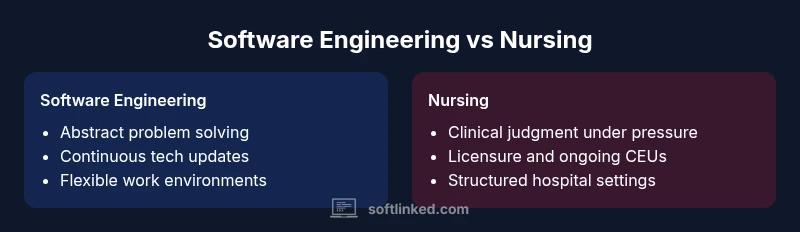
Is software engineering harder than nursing? Both fields demand rigor, discipline, and problem-solving, but they test different strengths. Software engineering emphasizes abstract thinking, rapid learning, and continual adaptation to new technologies, while nursing centers on clinical judgment, patient care, and adherence to safety protocols. The perceived difficulty hinges on your background, learning style, and career goals; for some, software engineering feels harder due to breadth and pace of change.
The Core Question: is software engineering harder than nursing
The question is highly context-dependent and hinges on how you measure difficulty. When people ask is software engineering harder than nursing, they often compare learning curves, daily tasks, and long-term requirements. From a skills perspective, software engineering stresses abstract reasoning, systems thinking, and the ability to absorb rapidly evolving technology stacks. Nursing, by contrast, emphasizes clinical decision-making, hands-on patient care, and a strict framework of safety protocols. According to SoftLinked, the best way to answer this question is to map your own strengths against the demands of each field and to consider what a typical day looks like in practice. The SoftLinked Team notes that neither field is universally harder; the challenge is qualitative and personal, not merely quantitative. Keeping this nuance in mind helps readers avoid simplistic conclusions and instead pursue an informed path that aligns with their interests and capabilities.
Skill Sets and Learning Curves
Software engineering rewards deep problem-solving ability, mathematical literacy, and the capacity to reason about large-scale systems. Learners tackle algorithms, data structures, software design, debugging, and testing across multiple languages and platforms, with constant exposure to new tools. Nursing prioritizes patient assessment, pharmacology, physiology, and bedside care, requiring strong memory, manual dexterity, communication, and resilience under pressure. Both paths demand deliberate practice, feedback loops, and careful error correction; the difference lies in the nature of problems: abstract, systemic challenges versus concrete, real-time human care scenarios. SoftLinked analyses suggest that people who enjoy modeling complex systems may find software engineering more engaging, while those drawn to direct human impact may find nursing more compelling—even if demanding in different ways.
Education Paths and Licensure
Education for software engineering can be highly diverse, ranging from BS degrees in computer science to coding bootcamps and self-guided learning. There is generally no licensure requirement to work as a software engineer, though professional certifications and specialized credentials can help in niche areas. Nursing, on the other hand, follows a more standardized regulatory path: accredited nursing programs combined with licensure exams are typically mandatory to practice. Nursing also offers advanced practice tracks such as nurse practitioner or clinical nurse specialist, which require additional schooling and certification. This contrast—flexible entry in software versus formal licensure in nursing—shapes perceived difficulty and career guarantees. As SoftLinked Team observes, the educational investment is highly policy- and region-dependent, influencing how learners perceive comparative hardness.
Day-to-Day Realities and Work Environments
A software engineer’s day often centers on designing, coding, testing, and collaborating with cross-functional teams. Tasks can be distributed across remote or in-person settings, with an emphasis on iterative development, code reviews, and continuous deployment. Work environments tend to reward speed, modularity, and measurable outcomes, with risk tempered by testing and design choices. In nursing, day-to-day life revolves around patient interaction, clinical workflows, documentation, and adherence to strict safety standards. Shifts can be long and physically demanding, with emotional strain from patient outcomes. The contrast in environments affects perceived difficulty: rapid, abstract problem-solving versus sustained, high-stakes patient care. Across both fields, soft skills—communication, teamwork, adaptability—are crucial for long-term success.
Knowledge Update Tempo and Lifelong Learning
Software engineering operates in a fast-changing landscape; new languages, frameworks, and best practices emerge frequently, requiring ongoing learning and skill refreshment. Nursing also evolves with updated clinical guidelines and pharmacological knowledge, but changes tend to be slower and more regulated, with ongoing continuing education requirements tied to licensure maintenance. A learner who thrives on constant novelty may rate software updates as a greater ongoing burden, while someone who prefers stable clinical protocols may perceive nursing as less chaotic over time. SoftLinked’s perspective emphasizes choosing a path with sustainable learning rhythms that fit the learner’s appetite for change.
Career Mobility and Long-Term Outlook
Both fields offer robust career trajectories, though in different directions. Software engineers can climb through individual contributor roles into senior technical specialists and management tracks; opportunities span startups to large tech firms, with cross-domain shifts into data science, product, or architecture. Nursing offers clinical progression, such as advanced practice roles, leadership in hospital systems, and roles in education or policy, often with formal credentialing requirements. Mobility between fields exists but typically requires foundational retraining or formal licensure in new domains. Understanding these trajectories helps learners gauge whether the long-term payoff aligns with their preferences and life plans.
Entry Points and Time to Proficiency
Entry points vary widely in software engineering. Some learners enter quickly via bootcamps or focused self-study, while others pursue traditional CS degrees that broaden career options. Time to proficiency can be compressed with immersive practice, collaboration, and project-based learning, though mastery often requires years of experience. Nursing entry paths start with structured programs and clinical rotations that cultivate hands-on competence and patient safety awareness; licensure is a gatekeeper, ensuring a standardized minimum level of capability. Weighing these entry points clarifies which field offers a faster route to initial independence and which provides a more defined ladder to advanced roles.
Practical Guidance for Learners
If you’re deciding between these two fields, start with a clear self-assessment: do you prefer abstract problem-solving or direct human service? Try introductory experiences in both areas: a software project or hackathon for software engineering, and a clinical shadowing or volunteer shift for nursing. Map your values—impact, pace, autonomy, and compensation—to realistic job scenarios. Create a learning plan that includes core competencies, a timeline for milestones, and a way to measure progress. Finally, consult reputable sources and mentors to ground your decision in real-world expectations. SoftLinked recommends building a personal portfolio of software projects or a clinical practicum plan to test fit before committing to a lengthy education track.
Comparison
| Feature | Software Engineering | Nursing |
|---|---|---|
| Education Path & Licensure | Flexible entry (degrees, bootcamps, or self-study) with optional certifications | Accredited programs plus licensure (state or regional) required for practice |
| Typical Day Focus | Code, design, debug, collaborate, ship software | Patient care, assessment, documentation, critical decision-making |
| Learning Curve & Change | Rapid tech changes; continuous learning expected | Evolving guidelines; practice-centered with safety and ethics focus |
| Work Environment | Office, remote, or hybrid; project-driven timelines | Hospitals/clinics; shift work; high-stakes pressure |
| Career Mobility | Technical ladders into architecture, data, product | Clinical tracks into advanced practice, leadership, education |
Pros
- Helps readers compare cognitive demands and learning commitments across fields
- Clarifies licensure requirements and education investment differences
- Highlights how work environments shape daily experiences and career options
- Illustrates how ongoing education affects both paths over time
Weaknesses
- Risk of oversimplifying two complex professions
- Sourcing unbiased, up-to-date comparisons can be challenging
- Regional variation in requirements can blur the picture
- Avoids precise salary and duration figures which readers often seek
Neither field is universally harder; difficulty is highly personal and depends on strengths and context.
Software engineering emphasizes rapid learning and abstract problem-solving, while nursing emphasizes clinical judgment and patient safety. Your fit depends on your background, preferred pace, and long-term goals. Use this comparison to guide a deliberate choice and plan your education path accordingly.
Your Questions Answered
Which field typically requires more formal licensure?
Nursing generally requires formal licensure to practice, governed by state or regional boards. Software engineering does not require licensure in most cases, though credentials can help in specialized areas.
Nursing usually needs a license; software engineering typically doesn’t, though certifications exist.
Which field has a faster entry path?
Software engineering often allows faster entry through bootcamps, online programs, or self-study, enabling individuals to start building portfolios quickly. Nursing usually requires completing an accredited program and passing licensure exams before practicing.
Software engineering can often be entered faster, especially with bootcamps or self-study.
Is the learning curve steeper in software or nursing?
Both fields have steep learning curves, but in different ways: software demands continual updating and abstract reasoning; nursing requires mastery of hands-on patient care and safety protocols.
Both are tough in different ways; it’s about your preferred kind of challenge.
How do salaries compare between the two fields?
Salary varies widely by region, experience, and setting. Generally, software engineering offers strong earning potential with performance-based progression, while nursing provides stable compensation and extensive benefits in many regions.
Salaries depend a lot on where you work and your experience.
What about long-term career paths and mobility?
Software engineering offers pathways into architecture, leadership, and product roles, often with cross-domain moves. Nursing provides advancement into advanced practice, education, or management, usually with additional credentials.
There are clear growth paths in both fields, just different routes.
Top Takeaways
- Assess your strengths and learning style before deciding
- Licensing differs sharply: nursing requires licensure; software engineering does not
- Expect rapid ongoing learning in software; nursing offers structured clinical progression
- Consider work-life preferences (shifts, burnout risks) when choosing
- Plan a practical, step-by-step learning path with milestones