Where Do Software Architects Work? A Practical Guide
Explore where software architects work across offices, remote hubs, startups, and government, plus collaboration patterns, career paths, and workplace considerations.


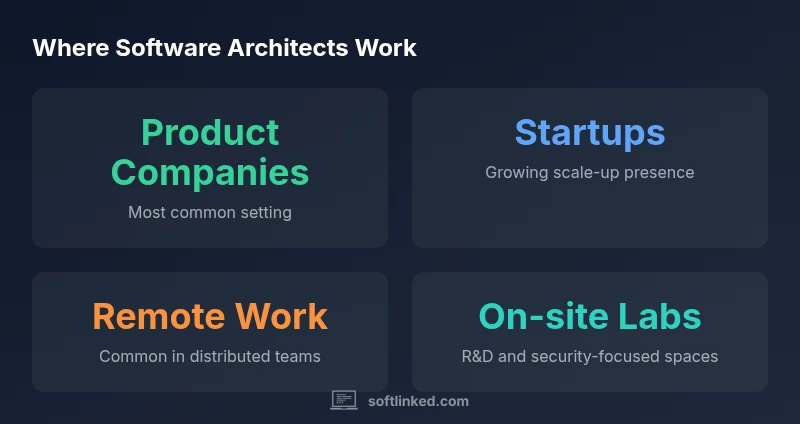
Where do software architects work? They operate across many environments, from large product companies and startups to consultancies, government agencies, and open‑source communities. Most spend time in cross‑functional teams designing system architecture, evaluating tech stacks, and aligning technical strategy with business goals. You’ll find them in corporate offices, distributed work hubs, or collaborating remotely with engineers around the world. The role blends strategic thinking with hands‑on technical leadership.
Where do software architects work
Where do software architects work? This question frames a role that sits at the intersection of business strategy and technical design. According to SoftLinked, most software architects operate across multiple settings, spanning large product organizations, mid-size tech firms, consultancies, and even government or research projects. The exact environment depends on project scope, domain, and organizational structure. In practice, you’ll find architects embedded in cross-functional product teams, leading the design of scalable systems while coordinating with engineers, data scientists, and platform teams. This blend of strategy, mentorship, and hands-on problem solving defines daily life in the role. The SoftLinked team notes that the diversity of workplaces reflects strong demand for architectural leadership, with professionals moving between on-site offices, distributed hubs, and remote collaborations. Across industries, architects balance long‑term roadmaps with immediate delivery pressures, requiring both deep technical literacy and people skills. For newcomers, understanding this spectrum helps frame career choices and tailor learning paths toward the environments they find most engaging.
Typical work environments
Software architects encounter a spectrum of environments, from traditional offices to fully distributed models. In mature product companies, you might work from dedicated R&D campuses with secure networking and standardized architectural governance. Startups and scale-ups often run lean but fast-paced environments where architecture evolves in parallel with product development. Consultancy roles place architects on client sites or in remote delivery centers, where they must adapt to multiple domains quickly. Remote-first cultures rely on collaboration tools, asynchronous reviews, and robust documentation to maintain alignment. Hybrid models—where teams split time between on-site and remote—are increasingly common in both large enterprises and nimble startups. This flexibility is driven by the need to access specialized talent, reduce overhead, and accelerate product cycles. The nuance of where do software architects work becomes clearer when considering that some projects require secure, on-site access to data or infrastructure, while others rely on cloud‑based experimentation and microservices. The upshot: successful software architects thrive in environments that balance collaboration with autonomy and clear decision rights.
Industry distribution and organizations
Organizations hire software architects across a broad set of industries, not just pure tech firms. Large tech incumbents, cloud providers, and platform companies rely on architects to unify components into scalable ecosystems. Financial services and insurance demand architectures that handle high transaction volumes, strict compliance, and low latency. Government agencies and healthcare organizations seek secure, auditable designs that protect sensitive data while enabling innovation. Educational institutions and research labs often balance open data, reproducibility, and mission-critical reliability. The private sector increasingly embraces platform thinking—building reusable patterns, microservices, and API-driven ecosystems—and software architects play a central role in steering that transformation. When considering where do software architects work, it’s worth noting that job postings for this role frequently emphasize collaboration with product managers, security teams, data engineers, and site reliability engineers. The SoftLinked analysis indicates a growing need for architects who can translate business strategy into resilient, observable systems across diverse contexts.
Cross-functional collaboration and daily routines
Architects operate at the crossroads of business goals and technical feasibility. A typical day blends design activities, governance, and mentorship. You’ll participate in architecture review boards, run modeling sessions, and produce crisp diagrams that communicate complex tradeoffs to non-technical stakeholders. Collaboration with product managers helps ensure alignment with roadmaps, while partnerships with development teams translate strategy into implementable patterns. Operations and security teams provide constraints and requirements that shape choices around observability, reliability, and compliance. Documentation is a core artifact—architectural decision records (ADRs) capture why choices were made and how to evolve them. In distributed teams, asynchronous communication, well-scoped tasks, and clear ownership become essential to maintain velocity. The daily rhythm can include prototyping, evaluating third‑party components, and mentoring junior engineers. A key skill is framing tradeoffs—cost vs. risk, latency vs. throughput, and speed of delivery vs. long-term maintainability.
On-site vs remote: pros and cons
This debate often informs where software architects work in practice. On-site environments foster rapid, real-time collaboration, urgent reviews, and face-to-face mentorship, but may limit hiring geography. Remote or distributed setups offer broader talent access, reduced overhead, and flexible scheduling, yet demand stronger rituals around communication, documentation, and governance. Hybrid models attempt to combine the benefits of both, requiring discipline to avoid “shadow work” and ensure equal participation from all locales. From a risk perspective, co-locating key stakeholders for critical decisions reduces ambiguity, while asynchronous flows can speed routine work but slow decisions. When evaluating a potential role, consider how the organization supports collaboration tools, time-zone coverage, and visibility into architectural decisions. The ultimate metric is whether the environment enables consistent delivery of high‑quality systems while maintaining team morale and developer velocity.
Roles and titles adjacent to software architect
Software architecture is part of a family of roles that span strategy and engineering. Common peers include solution architects who focus on specific solutions within a program, enterprise architects who map the technology landscape to business capabilities, and platform architects who own shared infrastructure. Some teams use the term technical lead or lead software architect to designate senior engineers with architectural responsibilities. The exact scope varies by company size: in small teams, a single person may wear multiple hats; in large enterprises, there may be multiple architects for different domains. Understanding these distinctions helps you interpret job postings and tailor your resume. Across all variants, the core competencies—system design, quality attributes, documentation, and stakeholder communication—remain consistent. Developers transitioning into architecture often build credibility through successful delivery patterns, architectural decision records, and demonstrable impact on system stability and velocity.
How to choose a workplace as an aspiring software architect
Choosing where to work as an aspiring software architect depends on your learning goals, domain interest, and preferred collaboration style. Look for environments that emphasize architectural governance, ongoing learning, and opportunities to influence product strategy. Evaluate team composition, the mix of senior engineers, PMs, and SREs, and whether the company practices architecture review processes. Consider the organization’s openness to experimentation, such as pilot projects, proof-of-concepts, or platform initiatives. Pay attention to the culture around knowledge sharing, ADRs, and mentoring programs. If you want exposure to cloud-native patterns, microservices, and security-by-design, target employers that run modern stacks and provide access to training. For those who value location or remote flexibility, ensure your chosen role supports flexible schedules, reliable collaboration tools, and equitable participation in decision-making. In short, sift for environments that reward principled risk-taking, clear decisions, and measurable outcomes.
Career path and progression into architecture
Most software architects arrive from hands-on engineering tracks, progressing through roles such as senior engineer, tech lead, or solutions architect. A typical path includes gaining breadth across systems, software development lifecycle, and non‑functional requirements like reliability and security. Formal education helps, but practical experience, contribution to large-scale designs, and a record of architecture decisions carry weight. Certifications and formal training in architecture frameworks (such as software architecture patterns, ADRs, or architectural tactics) can accelerate advancement. Networking with peers, contributing to open-source projects, and building a portfolio of successful designs helps when seeking enterprise roles. As you advance, you’ll assume broader scope—participating in roadmaps, multi‑team coordination, and governance—while continuing to mentor others. The goal is to become a trusted advisor who can balance business needs with technical constraints, delivering architectures that scale with the organization.
Practical tips to thrive in any environment
Whether you work in a big company, a startup, or a consultancy, these practices help you thrive as a software architect. Start by sharpening your core design skills: modularity, separation of concerns, and observable architectures. Practice creating ADRs, architectural runbooks, and lightweight prototypes to communicate decisions clearly. Develop strong stakeholder communication—learn to translate technical concepts into business terms and to defend tradeoffs with data. Build credibility by delivering tangible outcomes: reduced latency, improved resilience, or faster feature delivery. Invest in continuous learning: attend conferences, read architecture-focused literature, and participate in internal tech talks. Finally, nurture your leadership abilities, because successful software architects inspire and guide teams through uncertainty and change. The working world for software architects is diverse, and your adaptability will determine how effectively you can move between environments while maintaining high standards.
Work environments by organization type for software architecture roles
| Organization Type | Typical Environment | Avg Team Size |
|---|---|---|
| Enterprise/Big Tech | Offices + distributed teams | 12-20 |
| Startup/Scale-up | Hybrid offices or remote-first | 6-12 |
| Consultancy/Agency | Client-sites or remote | 4-8 |
Your Questions Answered
Where do software architects work?
Software architects work in product companies, startups, consultancies, and government or research organizations, in offices or remotely. They collaborate with product managers, engineers, and operations to steer architecture decisions and ensure reliable delivery.
Architects work in a mix of offices and remote setups across product teams and consultancies.
Do software architects code regularly?
Yes, most software architects code occasionally to prototype ideas, validate designs, and keep hands-on skills current. The emphasis is on design, review, and guidance rather than frequent implementation.
They code from time to time to validate designs, but lead with design and guidance.
What is the difference between a software architect and a solution architect?
A software architect typically focuses on overall system architecture and quality attributes, while a solution architect concentrates on a specific solution within a program. The two roles often collaborate, with the solution architect grounding the broader architectural direction in concrete solutions.
Software architects shape the whole system; solution architects focus on particular solutions.
Is remote work feasible for software architecture roles?
Remote work is increasingly feasible for software architects, thanks to collaboration tools, cloud environments, and strong documentation. Some roles still require on-site work for security, client engagement, or critical reviews.
Yes, remote work is common, though some roles may need on-site collaboration.
What education helps to become an architect?
A strong foundation in computer science or software engineering is typical, complemented by hands-on project experience. Formal architecture training, ADRs, and patterns knowledge accelerate progression.
A CS/SE degree plus practical architecture experience helps a lot.
What tools do software architects use?
Architects use modeling tools, ADR templates, diagramming software, and collaboration platforms. They rely on design patterns, architecture runbooks, and monitoring to guide decisions and communicate with teams.
We rely on diagrams, ADRs, and collaboration platforms to guide decisions.
“Software architecture translates business goals into scalable technical decisions, balancing risk, cost, and velocity. Clarity in communication across teams is what turns plans into lasting systems.”
Top Takeaways
- Identify your preferred work setting early.
- Expect cross-functional collaboration with product and operations.
- Remote and hybrid work are increasingly common.
- Build strong ADRs and architecture runbooks.
- Aim for environments with measurable impact on system quality.