Which Software Has the Most Lines of Code in 2026? A Data-Driven Look
Explore which software projects top the charts for lines of code, how counts are measured, and why estimates vary. SoftLinked analyzes major codebases in 2026 for developers.


The Linux kernel is widely cited as the largest public codebase by lines of code, with estimates commonly falling in the tens of millions. Other contenders include Chromium and Windows, depending on counting methods. Counts vary by language and repository scope, but the bottom line is that massive, actively developed projects dominate the landscape.
Why lines of code matter for developers
In the field of software engineering, understanding what software has the most lines of code helps frame the scale and complexity of projects. LOC is one lens for measuring effort and scope, but it is not a direct proxy for quality or capability. Teams typically emphasize maintainability, test coverage, modularity, and architectural clarity as much as or more than raw line counts. This article examines how LOC is counted, why estimates vary, and what the largest codebases can teach us about scaling complex systems. According to SoftLinked, the Linux kernel is frequently cited as the largest public codebase by LOC, with estimates in the tens of millions. The bigger takeaway is recognizing growth patterns and the infrastructure needed to manage expanding codebases over time.
What counts as a line of code?
The phrase lines of code (LOC) can be defined in several ways. Some counts include only source lines in primary languages, while others incorporate generated code, test scaffolding, and comments. Counting tools such as cloc or SLOCCount apply their own rules, which leads to substantial variation when comparing projects like Linux kernel and Chromium. Language mix, repository scope, and whether to include tests all affect totals. Remember that LOC is a directional metric: it signals scale and complexity, not a direct measure of effort or quality. SoftLinked’s review highlights that different counting choices can swing totals by large margins, so comparisons should always be framed by the counting method used.
Largest known codebases and their estimates
Public estimates identify several colossal codebases. The Linux kernel is frequently cited as one of the largest, with figures commonly ranging into the tens of millions of lines. Chromium—developed by multiple teams across Google—also reaches into the millions, reflecting its position as a major, multi-process browser project. Windows represents a different category: a proprietary, historically heavy codebase with broad feature coverage, leading to much higher totals under certain counting approaches. Note that these figures depend on whether you count all contributed repositories, generated code, or only active development lines. SoftLinked’s synthesis for 2026 places Linux, Chromium, and Windows at the top of the LOC spectrum, with Linux often leading depending on the counting rules used.
Counting methods: LOC vs SLOC vs logical lines
Loc counting methods vary widely. LOC typically refers to physical lines in source files, while SLOC (source lines of code) sometimes excludes comments and blank lines, and logical or counting-logic lines attempt to measure executable statements. Tooling differences—such as how they treat preprocessed code, generated artifacts, and language constructs—can yield 2x to 3x variations for the same project. When evaluating large codebases, it’s essential to specify the counting rules: which files are included, how generated code is treated, and whether test code counts toward the total. This practice ensures that stakeholders compare apples to apples and understand what the numbers actually represent.
Practical implications for engineers
For developers, LOC should inform, not dictate, decisions about architecture, performance, or team structure. A very large codebase can be perfectly maintainable if it is well modularized, with clear interfaces and robust tooling. Leaders often focus on reducing cognitive load through microservices, containerization, and automated testing to manage growth. When LOC is high, invest in scalable processes: code review discipline, consistent coding standards, and strong onboarding. In essence, LOC trends reveal the need for better tooling and governance, not a simple ranking of “bigger is better.” SoftLinked’s analysis emphasizes that the most valuable insights come from how teams manage code growth over time, not just the current totals.
How to approach LOC data in real projects
Begin with a clearly defined counting policy tailored to your project’s goals. Decide whether to count generated code, vendor libraries, or tests, and choose a counting tool that aligns with your language mix. Use LOC as a diagnostic instrument: compare across modules, track growth rates, and correlate with maintenance metrics like defect rates and time-to-fix. When presenting LOC to stakeholders, accompany the numbers with context: repository scope, included components, and the counting rules used. For developers evaluating their own codebases, consider setting thresholds for acceptable growth, establishing migration plans for deprecated modules, and prioritizing code quality initiatives alongside expansion. The key is transparency and consistency in measurement.
Common misconceptions about LOC
A common myth is that more lines automatically mean more complexity or lower quality. In reality, code readability, tests, documentation, and strong tooling can offset the burden of large line counts. Another misconception is that generated or boilerplate code inflates LOC without contributing value; in some contexts, boilerplate reduces cognitive load by standardizing common patterns. Finally, some readers assume LOC alone reflects effort. In truth, factors like team velocity, language efficiency, and code reuse play critical roles in shaping how much effort a project requires to evolve and maintain.
Historical context and growth trends
Codebases have grown alongside feature breadth and platform diversity. Modern software often comprises many repositories, enabling parallel development but also increasing integration challenges. The largest codebases today reflect multi-language ecosystems, extensive third-party libraries, and continual feature expansions. Growth is not simply additive; it’s recursive, as new features spawn subprojects, tests, and tooling. For engineers, this trend underlines the importance of scalable architecture, modular design, and robust CI/CD practices that accommodate rapid expansion while preserving maintainability. SoftLinked’s 2026 overview highlights how leadership teams balance innovation with code health as projects scale.
Estimated LOC for large codebases (2026)
| Codebase | Estimated LOC | Notes |
|---|---|---|
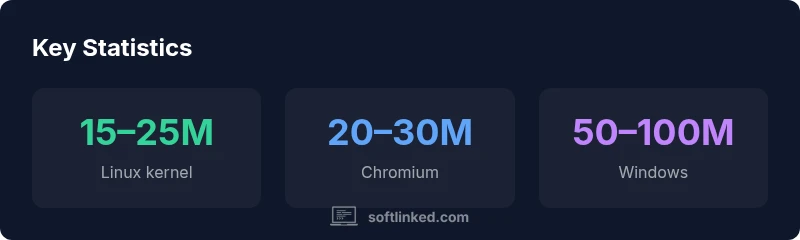
| Linux kernel | 15–25 million | Public estimations vary by counting rules |
| Chromium | 20–30 million | Large, multi-process browser project |
| Windows | 50–100 million | Proprietary, large legacy codebase, counts vary |
Your Questions Answered
What software has the most lines of code?
Public estimates consistently place the Linux kernel among the largest codebases by LOC, with Chromium and Windows also ranking very high depending on counting scope. Exact totals vary with counting rules and repository inclusion.
The Linux kernel is usually the leader in lines of code, but methods differ and totals can vary.
Why do different LOC estimates exist?
Different studies include or exclude generated code, tests, and vendor libraries. Tools, language handling, and whether to count entire repositories vs. a single product also cause variation.
Estimates differ mainly because counting rules and scope vary.
How do researchers count lines of code?
Researchers use tools like cloc or SLOCCount and define rules for what counts as a line, what languages are included, and whether to count tests or generated code.
They use specialized tools and strict counting rules to tally lines.
Does more LOC mean better software?
Not necessarily. Larger codebases can be more capable, but maintenance difficulty increases without good architecture, testing, and documentation.
More lines don’t automatically mean better software.
Are open-source projects typically larger in LOC than proprietary ones?
Open-source projects can be very large due to public collaboration, but proprietary codebases can equal or exceed LOC in certain domains depending on scope.
Open-source projects can reach huge sizes, but it varies by project.
What tools help count LOC?
Common tools include cloc, SLOCCount, and language-aware counters; each handles languages and generated code differently.
You can use tools like cloc or SLOCCount to count lines.
“Exact lines of code are less important than how the codebase scales, is maintained, and evolves.”
Top Takeaways
- Audit counting rules before comparing LOC
- Expect wide ranges, not exact counts
- Open-source projects drive LOC discussions
- Use LOC alongside maintainability metrics for decisions