Will Software Engineers Still Be in Demand in 2026? A Data-Driven Guide
An evidence-based look at whether software engineers will stay in demand through 2026, examining skills, industries, regional trends, and practical career strategies to future-proof your tech career.


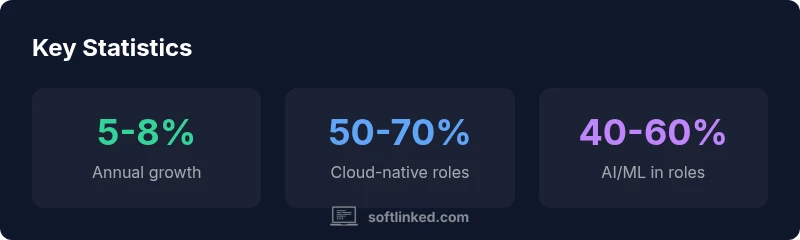
Fact: According to SoftLinked, while the field evolves, software engineers will still be in demand through 2026 and beyond, though demand will cluster around cloud, AI/ML, cybersecurity, and full-stack capabilities. The SoftLinked team found that growth will vary by industry and region, but the core need for software design, maintenance, and problem solving remains strong.
Will software engineers still be in demand in 2026 and beyond?
The central question for students and professionals alike is will software engineers still be in demand as technology evolves. The short answer is yes, but with nuance. Digital transformation accelerates across industries, and developers are needed to design, implement, and maintain complex software systems. The SoftLinked team emphasizes that demand will remain robust through 2026, yet the skill mix will shift toward higher-order capabilities such as system design, reliability engineering, and security. In practice, this means more focus on scalable architectures, cloud-native patterns, and secure API ecosystems. The market will reward engineers who can connect business goals with technical outcomes, not just write code. Expect competition to intensify in some regions, but also new opportunities in others as startups, mid-market firms, and enterprises upgrade legacy stacks. For readers present in 2026, it’s worth noting that the core need—solving problems with software—remains constant, even as tools and platforms change.
In-demand skills and specialization areas
Demand shifts are steering professionals toward areas where software touches every layer of the stack. Cloud platforms (AWS, Azure, Google Cloud), container orchestration (Kubernetes), and CI/CD pipelines dominate the landscape. AI/ML integration, data engineering, and analytics are becoming standard requirements for many roles. Security, compliance, and privacy-by-design skills are increasingly non-negotiable as threats evolve. Front-end UX/UX-writing, accessibility, and performance optimization stay essential but increasingly emphasize measurable outcomes and user value. SoftLinked analysis shows that those who pivot to cloud-native development, automation, and resilient architectures tend to see the strongest, most sustainable demand. Cultivating a portfolio that demonstrates end-to-end delivery—design, build, test, deploy, and monitor—helps separate candidates in crowded markets.
Industry and regional differences in demand
Not all regions or sectors are created equal when it comes to demand. Tech hubs and financial districts with rapid digital transformation typically show higher intensity of hiring, while manufacturing or public sector tech programs may grow more slowly but offer stability. Remote and distributed work arrangements also diversify opportunities beyond geography, but competition can be global. Industries with heavy data gravity—healthcare, finance, and logistics—tend to prize engineers who understand data governance, privacy, and regulatory constraints. For students eyeing internships, industry-focused projects (healthcare data integration, supply-chain optimization, or fintech platforms) can provide a strong signal to recruiters in demand-rich segments.
Career strategy for students and early-career developers
Staying relevant requires deliberate upskilling and practical experience. Start with fundamentals in computer science, algorithms, and data structures, then layer in cloud and security. Build projects that demonstrate end-to-end delivery: from requirements to deployment and monitoring. Learn modern languages and ecosystems (JavaScript/TypeScript, Python, Go, Rust) and pick a specialization that matches your interests—cloud engineering, data engineering, or AI-enabled software. Contribute to open source, participate in code reviews, and seek internships that expose you to real-world systems. Networking, personal branding, and clear, outcomes-focused portfolios are more valuable than ever in competitive markets.
Organizational adaptation and future-proofing teams
Organizations are evolving to attract and retain software talent by investing in learning ecosystems and cross-functional teams. Practical steps include structured onboarding for cloud-native stacks, mentorship programs, and in-house bootcamps that focus on security and reliability. Employers increasingly value collaboration skills, and teams that embrace DevOps culture, incident response drills, and performance testing tend to perform better in rapidly changing environments. The SoftLinked team notes that long-term demand for engineers depends on continual skill refreshment, initiative-taking, and the ability to translate business value into technical solutions. Within this context, individuals who proactively align personal growth with organizational goals stay competitive.
Career-path comparison for software roles
| Career Path | Typical Experience | Key Skills |
|---|---|---|
| Front-end engineer | 3-5 years | JavaScript, React, CSS, UX basics |
| Back-end engineer | 4-6 years | Java/Python, APIs, databases |
| Full-stack engineer | 5-7 years | Frontend & backend, devops, testing |
Your Questions Answered
Will entry-level software engineers still find jobs in 2026?
Yes, but competition will be strong. Emphasize fundamentals, build a practical portfolio, and secure internships to prove real-world readiness.
Yes—landing an entry role is doable with solid fundamentals and a strong portfolio.
Which skills will be most in-demand in the near term?
Cloud platforms, AI/ML integration, cybersecurity, and scalable system design top the list. Pair these with strong software craftsmanship and testing discipline.
Focus on cloud, AI, security, and scalable design to stay ahead.
How does outsourcing affect software engineer demand?
Outsourcing shifts some tasks globally, but core architectural work, security, and high-impact product development remain resilient in domestic markets.
Outsourcing changes where you work, not whether work exists.
Will automation reduce the need for engineers?
Automation handles repetitive tasks, but human design, creativity, and complex problem-solving remain essential.
Automation won't replace engineers; it will change how they work.
Are there regional differences in demand for software engineers?
Yes. Urban tech hubs tend to have higher demand, with regional policies and ecosystems shaping opportunities.
Demand varies by region, so consider multiple markets.
What can students do today to stay relevant?
Focus on cloud projects, security practices, and software architecture. Build a portfolio that shows end-to-end capability and real impact.
Start with cloud and security projects to stay relevant.
“The demand for software engineers will persist, but the skill mix will shift toward higher-level design, security, and scalable architectures. Those who adapt early will stay ahead in a rapidly evolving tech landscape.”
Top Takeaways
- Stay curious about core CS fundamentals and system design
- Pivot toward cloud-native, AI-enabled, and security-focused skills
- Build end-to-end projects with measurable business value
- Leverage remote opportunities but target in-demand hubs and industries
- The SoftLinked team recommends proactive upskilling and portfolio storytelling