Can You Get a Software Engineer Job with No Experience? A Practical Guide
Learn practical, step-by-step strategies to break into software engineering without prior work experience. Build a standout portfolio, master essential fundamentals, and ace interviews with actionable timelines and tips.


Yes—it's possible to land a software engineer role with no formal experience by focusing on concrete projects, learning core fundamentals, and demonstrating practical skills. You’ll need to build a portfolio of self-driven projects, contribute to open-source, master essential tools like Git and Linux, and craft a narrative that shows problem-solving and learning ability. Start with a plan and a tight personal pitch.
Why the dream is achievable in 2026
The question can you get a software engineer job with no experience is more relevant today than ever. The SoftLinked team has observed a shift in hiring toward demonstrable ability rather than formal pedigree. Many junior roles are now filled by candidates who show real code, persistence, and the capacity to learn quickly. This doesn’t mean certificates or degrees are irrelevant, but it does mean you can compete through tangible projects, thoughtful learning, and a clear career narrative. With a strategic plan, you can validate your readiness through portfolio work and structured practice, rather than waiting for traditional work experience to appear.
According to SoftLinked, the bottleneck for new developers is often visibility of skill, not capability alone. Demonstrating your problem-solving approach in code, documenting decisions, and communicating clearly with peers can close the gap. If you’re asking can you get a software engineer job with no experience, the answer becomes practical: build evidence you can ship software and learn quickly. This article walks you through a proven path that aligns learning with actual outcomes.
- Build tangible projects
- Learn the essentials that employers expect in juniors
- Communicate outcomes effectively to recruiters and teams
How to build relevant experience without a traditional job
You don’t need a paid internship to prove your abilities. Start by choosing 1–2 core projects that showcase real functionality, then expand to 2–3 supplementary builds that demonstrate breadth. Open-source contributions or freelance gigs—even small tasks—can count as experience when you frame them properly. Each project should have a clear goal, a public repository, a readable README, and a deployed or runnable version if possible. When recruiters ask, you want to point to working code, documented decisions, and measurable outcomes. Keep your focus narrow at first: target a stack you enjoy and can confidently discuss in interviews. Building a consistent portfolio is far more impactful than starting ten projects you never finish.
A practical approach is to map your learning to real problems: a small CRUD app, a command-line tool, or a data analysis notebook that solves a user problem. As you accumulate more work, you’ll be able to compare your progress against job descriptions for junior roles. SoftLinked’s guidance emphasizes tangible outcomes over theoretical study, helping you answer the central question for recruiters: can you actually ship software? By curating a coherent body of work, you’ll show you can learn, adapt, and contribute from day one.
- Start with 1–2 focused projects
- Add 1–2 open-source contributions to demonstrate collaboration
- Deploy something visible (a hosted app or documented project) for easy sharing
Core skills to learn when you have no work experience
A strong foundation is non-negotiable. Prioritize the skills most often required for entry-level software engineering roles:
- Core programming languages: pick one front-end (JavaScript/TypeScript) and one back-end (Python, Java, or Node.js)
- Data structures and algorithms basics: arrays, linked lists, trees, sorting, and problem-solving patterns
- Version control: Git workflows, branching strategies, pull requests, and code reviews
- Debugging and testing: writing unit tests, using debugging tools, and understanding test pyramids
- APIs and data handling: RESTful design, JSON, and basic database operations
- Linux fundamentals: shell basics, navigation, permissions, and scripting
- Software development lifecycle: planning, estimating, versioning, deployment, and maintenance
- Documentation and communication: README quality, inline comments, and changelogs
- Security basics: input validation, authentication concepts, and common vulnerabilities
By mastering these areas, you’ll be able to discuss technical decisions in interviews and demonstrate readiness for junior teams. Remember, depth in a couple of areas often beats shallow breadth across many topics. Your portfolio should reflect a coherent story of growing competence in chosen tools and practices.
- Focus on 2–3 core languages and tools
- Practice explaining why you chose a solution
- Build up a library of reusable components for future projects
Showcasing learning through a portfolio and resume
Your portfolio is your primary asset when you have no professional experience. Create a public repository strategy and a simple personal site or GitHub Pages to host your work. Each project should have:
- A clear problem statement and user story
- A well-structured README describing goals, architecture, and trade-offs
- Link to deployed versions or runnable demos when possible
- A short, honest reflection on what you learned and what you’d improve next
Your resume should tell a compelling story, emphasizing: the problems you solved, the impact of your projects, and the learning journey. Use a clean, scannable format with bullets, quantify outcomes where possible (percent improvement, reduced load time, etc.), and include a link to your portfolio. A concise LinkedIn profile that mirrors your portfolio helps recruiters quickly validate your claims.
- Include a strong project section with URLs
- Use action verbs and concrete results in bullet points
- Align resume language with junior software engineer job descriptions
Networking and interview strategies
Networking remains a powerful lever for breaking into software engineering without traditional experience. Start by reaching out to junior engineers, mentors, and alumni who work in roles you aspire to. Personalize messages that reference specific projects you’ve built and ask for 15 minutes of feedback or guidance rather than a job. When you land conversations, prepare a concise narrative: what you built, why it mattered, and how you’ll contribute as a team member.
Interviews for junior roles often emphasize problem solving and collaboration. Practice coding problems regularly, but also prepare to discuss your projects in detail: the technical choices, trade-offs, and lessons learned. Use the STAR method to describe past experiences even if they’re self-driven. Mock interviews with peers or online communities can help reduce nerves and improve clarity. Finally, tailor each application: mention how your projects map to the company’s tech stack and product goals.
- Build 2–3 strong professional relationships per month
- Prepare a concise project narrative for interviews
- Use STAR to structure behavioral responses
- Practice common junior-level coding problems regularly
Timelines and realistic expectations
Breaking into software engineering without experience is a marathon, not a sprint. A practical timeline looks like:
- Month 1–2: Define goals, select your stack, and start 1–2 core projects with complete READMEs
- Month 2–4: Expand to 2–3 more projects, merge open-source contributions, and deploy or demonstrate results
- Month 3–5: Build a public portfolio site and optimize your resume/LinkedIn
- Month 4–6: Begin applying to junior roles, conduct mock interviews, and refine your pitch based on feedback
The exact pace varies by you, the market, and the quality of your portfolio. Consistency beats intensity; steady weekly progress compounds into job opportunities. Keep a learning journal to capture what works and what doesn’t, and use feedback to adjust your plan.
- Expect 3–6 months of dedicated preparation for initial applications
- Track progress with a simple kanban or checklist
- Revisit your portfolio every few weeks to improve clarity and depth
Common mistakes to avoid
Avoid common missteps that can derail your efforts:
- Overlooking documentation: a project without a good README is hard to evaluate
- Zeros to hero in one project: multiple tiny projects look unfocused; aim for quality over quantity
- Misrepresenting experience: be honest about your level and learning stage
- Neglecting portfolio polish: inconsistent naming, broken links, or missing deployment hurts trust
- Failing to tailor applications: generic resumes waste recruiter time
- Skipping interview practice: theoretical knowledge without practical explanation falls flat
Being mindful of these mistakes helps you present a credible, professional image even without formal work history.
A practical 90-day plan to get started
Day 1–14: Define your target role and stack; set up GitHub, a portfolio site, and a basic project skeleton.
Day 15–45: Build 1–2 core projects with end-to-end functionality; write compelling READMEs and deploy where possible.
Day 46–75: Contribute to open-source or small paid gigs; begin documenting decisions and trade-offs in PRs.
Day 76–90: Polish resume/LinkedIn, prepare interview stories, and run mock interviews with peers. Start applying to junior roles with personalized messages.
Following this plan, you’ll create verifiable evidence of your abilities and a narrative recruiters can trust. Adjust pace as needed, but keep momentum and learning momentum intact.
Next steps and SoftLinked's guidance
The SoftLinked team recommends turning learning into demonstrable software artifacts. Even without a traditional resume in software development, your portfolio, real projects, and interview readiness determine your early career trajectory. Stay curious, seek feedback, and iterate quickly. As you accumulate projects and conversations with mentors, your confidence and market value rise. Remember that persistence and clarity in your story often beat the lack of formal experience when recruiters evaluate junior candidates.
Tools & Materials
- Laptop or desktop computer(Sufficient performance for compiling code and running local apps)
- Reliable internet connection(Stable bandwidth for remote work and online learning)
- Code editor (e.g., VS Code)(Install linters and extensions for JS/Python/Java workflows)
- Git and GitHub account(Learn basic commands: commit, push, pull, branch; set up SSH keys)
- Local runtimes (e.g., Node.js, Python, Java)(Match languages you plan to build projects in)
- Project templates or starter kits(Have 2–3 starter projects ready to customize)
- Open-source/internship opportunities (optional)(Contribute to real repos to demonstrate collaboration)
- Portfolio hosting (GitHub Pages/Netlify, etc.)(Showcase your projects publicly)
Steps
Estimated time: 3-6 months
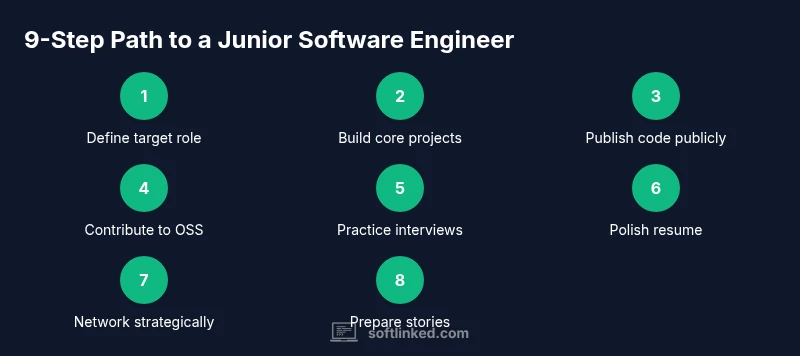
- 1
Define your target role and stack
Identify 1–2 junior software engineer roles that excite you and the languages/tools they emphasize. This will guide project choices and vocabulary for interviews, ensuring your learning is purpose-driven.
Tip: Choose a stack you enjoy; motivation compounds learning. - 2
Build 1–2 core projects
Create end-to-end projects that solve real problems. Prioritize clean architecture, meaningful features, and robust READMEs to communicate your decisions to others.
Tip: Document decisions and trade-offs in the README. - 3
Set up public code repositories
Publish your code with well-organized folders, comments, and tests. Include a short README for each project that describes goals, tech, and how to run it.
Tip: Use meaningful commit messages and maintain consistent styles. - 4
Contribute to open-source or internships
Join small, manageable open-source tasks or short-term freelance gigs to demonstrate collaboration and real-world code reviews.
Tip: Ask for feedback and reflect on code review comments. - 5
Practice coding interviews
Schedule regular problem-solving sessions (LeetCode/CodeSignal) and explain your reasoning aloud. Focus on algorithmic patterns and translating ideas into code.
Tip: Use the think-aloud approach to show your process. - 6
Polish resume and LinkedIn
Craft a concise narrative linking your projects to job outcomes. Highlight problems solved, technologies used, and learning milestones.
Tip: Tailor each application to the job description. - 7
Network strategically
Reach out to engineers and alumni with personalized notes referencing your projects and questions about their work. Aim for informational chats, not instant offers.
Tip: Keep outreach brief and actionable. - 8
Prepare interview stories
Develop clear STAR stories around your projects, challenges faced, and how you learned. Practice with a friend or mentor to refine delivery.
Tip: Frame failures as learning experiences and show improvement.
Your Questions Answered
Can you really get hired as a software engineer with no experience?
Yes. Many junior software roles are filled by candidates who demonstrate solid projects, learning agility, and practical coding skills. A strong portfolio often outweighs a lack of formal job experience when paired with interview readiness.
Yes. A strong portfolio and interview preparation can land junior software roles even without prior experience.
What is the fastest path to a junior developer role?
Focus on 1–2 projects that showcase end-to-end functionality, deploy them, and tailor applications to target job descriptions. Pair with open-source contributions to demonstrate collaboration and reliability.
Concentrate on a couple strong projects and open-source work to build credibility quickly.
Are internships or apprenticeships worth it for beginners?
Yes. Internships provide structured learning, mentorship, and a bridge to paid roles. If unavailable, substitute with personal projects and open-source contributions to simulate the same learning environment.
Internships help, but strong self-initiated projects can substitute when internships aren’t accessible.
How important is a GitHub portfolio for entry-level roles?
Very important. A well-organized GitHub with readable READMEs, clear project goals, and demonstrated progress signals reliability to recruiters.
Your GitHub is a key handshake with employers—keep it tidy and informative.
Should I focus on algorithms for entry-level roles?
Yes, but balance it with practical projects. Employers want to see you can ship features, not just solve puzzles. Include both problem-solving examples and hands-on projects.
Algorithms matter, but real-world projects carry equal weight for juniors.
What if I come from a non-CS background?
A non-CS background is common. Emphasize transferable skills, show you’ve built relevant projects, and articulate how your perspective adds value to a software team.
Your non-CS background can be a strength if you show applicable projects and learning.
Watch Video
Top Takeaways
- Build real projects to prove capability
- Document decisions clearly to communicate thinking
- Tailor applications to each job description
- Practice storytelling using the STAR framework